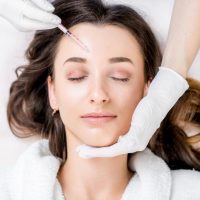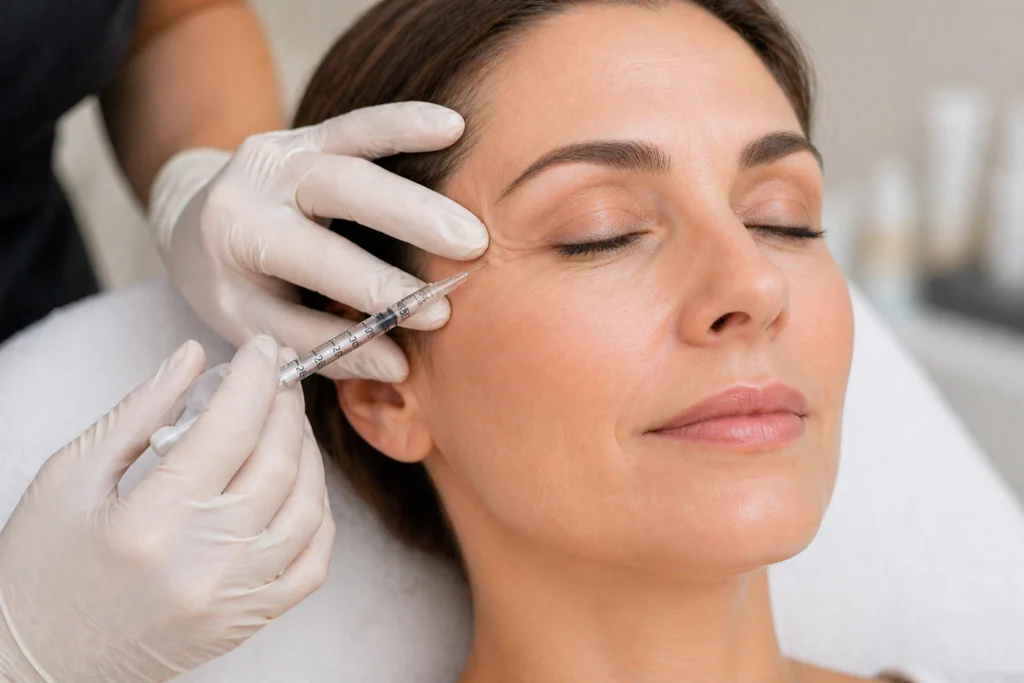
Yes, you can wear makeup after Botox, but you should wait at least 4 hours and ideally a full 24 hours before applying anything to the treated area. Each injection leaves a tiny puncture in the skin, and foundation applied over an open puncture can carry bacteria into it. Pressing and blending also puts pressure on skin where the product has not yet bound to the muscle. Below we cover exactly how long to wait, why providers give different numbers, what happens if you apply makeup too early, and how hats, sunglasses, face washing, and makeup removal fit into the same first day.
Can I Wear Makeup After Botox?
You can wear makeup after Botox once the injection sites have closed and settled, which means waiting a minimum of 4 hours and preferably until the next morning. Nothing about makeup is inherently harmful to the product itself. The concern is the combination of an open puncture, a brush that has touched your face many times before, and the pressure of blending.
Pressure and bacteria are the two variables worth controlling, and both fade quickly. Botulinum toxin injection is the most commonly performed minimally invasive cosmetic procedure in the United States, according to a 2026 review in American Family Physician, and the American Society of Plastic Surgeons recorded 4.7 million botulinum toxin type A procedures in 2023, a 6% increase over the prior year. The overwhelming majority of those patients return to a normal routine the same day.
Returning to normal quickly is the point of the treatment. Botox injections take about 10 to 20 minutes and require no downtime, so the aftercare that matters is measured in hours rather than days.
How Long After Botox Can You Wear Makeup?
You can wear makeup 4 hours after Botox at the earliest, and waiting a full 24 hours gives the injection sites the widest margin. Between those two marks, the risk drops steadily rather than falling off a cliff at any particular hour.
Hours are easier to plan around when the whole first day is laid out at once. Makeup is one item on a longer list, and several other activities share the same clock.
| Activity | How Long to Wait | Reason |
|---|---|---|
| Applying makeup to treated areas | 4 hours minimum, 24 hours ideal | Injection sites need to close before products or tools touch them |
| Washing your face | No wait, use a light touch | Water does nothing to the product; friction is the only concern |
| Lying down | 3 to 4 hours | Staying upright keeps the product where it was placed |
| Rubbing or massaging the face | 12 to 24 hours | Product can spread about half an inch when the area is massaged |
| Wearing a tight hat or headband | 24 hours | Sustained pressure across the forehead acts like slow massage |
| Wearing glasses or sunglasses | 4 hours for most, longer for crow’s feet | Frames rest on the nose bridge and temples |
| Strenuous exercise | 24 hours | Raised blood pressure can increase bruising |
| Facials and massages | 24 hours minimum | Both involve sustained rubbing of treated skin |
Sources: Cleveland Clinic; American Family Physician, 2026; Journal of the American Academy of Dermatology, 2018.
Treat the table as a floor rather than a ceiling. Waiting longer than any figure listed costs nothing.
Why Makeup Timing Advice Differs Between Providers
Makeup timing advice differs between providers because clinicians weigh a small, well-understood risk differently, not because anyone is wrong. Cleveland Clinic takes the most permissive position, noting that injection sites close in roughly 15 minutes and that makeup, lip balm, or anything else can essentially be used any time after that, with care taken not to rub the area. Most clinics, including ours, recommend 4 to 24 hours.
The gap between 15 minutes and 24 hours is a gap in caution, not in biology. A closed puncture is genuinely closed. The extra hours account for the parts nobody can control from a treatment chair: whether your brushes were cleaned recently, how heavy-handed you are with a beauty sponge, and whether you will remember to skip the treated spots.
Skipping those variables entirely is the simplest path. We tell patients in Lee’s Summit to plan on a bare face for the rest of the treatment day, because a single evening without foundation removes every one of those unknowns at no cost.
What Happens if You Wear Makeup After Botox Too Soon?
Wearing makeup too soon after Botox can introduce bacteria into open injection sites, shift the product before it binds to the muscle, and hide early bruising that you would otherwise notice. None of these is common, and all three are avoidable by waiting.
Bacterial introduction is the most cited concern across clinics. Makeup brushes, sponges, and fingertips collect bacteria between washes, and a fresh puncture is an entry point that normal intact skin is not. Infection after Botox is rare, but it is the one complication that patient behavior can genuinely influence.
Migration is the second concern and it responds directly to pressure. Botox is a liquid, and Cleveland Clinic notes it can spread roughly half an inch when the area is massaged, which is enough to affect a neighboring muscle that was never meant to be treated. Vigorous blending across the forehead is a mild version of the same motion. If you want the mechanics behind why placement is so precise, how Botox works explains the muscle-nerve relationship in more detail.
Masked bruising is the quietest of the three. Small bruises are the most common side effect of injections, most often in the laugh line area where blood vessels are dense, and covering them on day one means you may not spot swelling or redness that is worth mentioning to your injector. A few practical steps can reduce swelling in the first hours if it appears.
Can Botox Migrate After 3 Days?
Botox does not meaningfully migrate after 3 days, because the toxin has already bound to the muscle receptors by roughly 24 to 48 hours after injection. Once that binding happens, the product is no longer a free liquid that pressure can push around.
Binding is why every aftercare rule concentrates on the first day or two. After 48 hours, rubbing your face, sleeping face-down, or wearing a hat has no bearing on where the product sits. Patients who worry on day four about something they did on day three are almost always worrying about a window that has already closed.
Closing that window quickly means the restrictive part of aftercare is genuinely short. Two days of mild care buys you three to four months of results.
What Is the 4-Hour Rule for Botox?
The 4-hour rule for Botox means staying upright for about 4 hours after your injections rather than lying down, bending over repeatedly, or napping. Cleveland Clinic frames the window as 3 to 4 hours. Staying vertical keeps the product settled where it was placed while it begins binding.
Vertical posture matters for the same reason pressure does. Gravity and position both influence a liquid that has not yet attached to its target, and lying flat shortly after treatment tilts the odds slightly in the wrong direction.
Four hours is also a convenient anchor for the rest of the day, since it lines up with the earliest reasonable makeup window. Schedule your appointment in the morning and both timers run out well before bed.
How Soon Can You Lay Down After Botox?
You can lay down 3 to 4 hours after Botox, which is the same window covered by the 4-hour rule. Sitting upright, standing, walking, and normal desk work are all fine immediately.
Bending forward repeatedly falls into the same category as lying flat. Loading a dishwasher once is not a problem. An hour of gardening with your head below your heart is worth pushing to tomorrow.
What Must You Not Do After Botox?
After Botox you must not rub or massage the treated area, lie flat for the first few hours, exercise strenuously, or book a facial or massage for at least 24 hours. Everything else in your normal day is generally fine.
The full first-day list is short:
- Do not rub, massage, or scratch the treated area for at least 12 to 24 hours.
- Do not lie flat for the first 3 to 4 hours.
- Do not apply makeup to injection sites for at least 4 hours, ideally 24.
- Do not exercise strenuously for 24 hours, since raised blood pressure can increase bruising.
- Do not book a facial, massage, or microdermabrasion for at least 24 hours.
- Do not use retinol, glycolic acid, or salicylic acid on the treated area for 24 to 48 hours.
- Do not drink alcohol on treatment day, because it dilates blood vessels and can worsen bruising.
- Do not wear a tight hat, headband, or swim cap across a treated forehead for 24 hours.
Two things are worth adding that often surprise people. You can smile, frown, and be as expressive as you like, since moving your face does not affect the product. One 2018 study published in the Journal of the American Academy of Dermatology found that 68% of participants felt facial exercises sped up their results, though the evidence is mixed. Our neurotoxin treatments are placed precisely enough that normal expression is never the problem.
Pressure, rather than expression, is the thread running through the entire list. That principle extends well past makeup into everything else that rests on your face.
Can You Wear a Hat After Botox?
You can wear a loose hat after Botox, but you should skip tight hats, headbands, visors, and helmets across a treated forehead for the first 24 hours. Almost no aftercare guide mentions headwear, and it deserves attention because a hat applies exactly the kind of pressure the rubbing rule exists to prevent.
Pressure from a hatband is different from a quick touch. A baseball cap worn tight sits directly across the frontalis muscle, which is the most commonly treated area on the face, and it holds that pressure steadily for however long you wear it. Continuous mild compression across a treated forehead is closer to a slow massage than to an incidental brush.
Compression is the deciding factor rather than the hat itself. A wide-brimmed sun hat resting loosely on the crown of your head barely touches the forehead and is fine within a few hours. A snug beanie pulled down to the brows is the version worth postponing.
How Long After Botox Can You Wear a Hat?
You can wear a hat 24 hours after Botox if it fits snugly across the forehead, and within about 4 hours if it sits loosely and does not press on treated areas. The same 24-hour window applies to headbands, sweatbands, and anything elastic that crosses the brow.
Helmets deserve their own note because they combine pressure with heat and often with exercise. Wait the full 24 hours before cycling or riding, which also satisfies the exercise guidance.
Can You Wear Sunglasses or Glasses After Botox?
You can wear glasses and sunglasses after Botox, and for most treatment areas there is no meaningful restriction beyond the first few hours. Frames rest on the nose bridge and the temples, and neither area is treated in a standard forehead or frown line appointment.
Treatment area determines the answer here, which is why a blanket rule does not work. If you had crow’s feet treated, the arms of your glasses pass close to the lateral canthal region, and heavy frames can press on it. If you had only the forehead or glabellar lines treated, your glasses are nowhere near the injection sites.
Prescription wearers should never go without glasses for safety reasons, and no injector would ask them to. Light frames worn normally are fine. What we suggest avoiding for the first day is pushing glasses up into your hair repeatedly or resting them on top of a treated forehead, since that drags across the skin. The specific areas of the face you had treated determine how much of this applies to you.
Can You Wash Your Face After Botox?
You can wash your face after Botox on the same day, as long as you use a light touch and a mild cleanser. Water does nothing to the product. Cleveland Clinic is direct on this point, noting that Botox will not wash away, and that the only thing to avoid is rubbing the treated area or aggravating any bruising.
Rubbing is the entire concern, which means technique matters more than timing. Use lukewarm water, apply cleanser with fingertips in gentle circles away from injection sites, rinse without scrubbing, and pat dry with a soft towel instead of wiping.
Skip the tools for the first day. Cleansing brushes, exfoliating cloths, and scrubs all apply the friction we are trying to avoid, and none of them are necessary for one evening. Anything more involved, including facial treatments like peels or microdermabrasion, waits at least 24 hours.
How Should You Apply Makeup After Botox?
You should apply makeup after Botox with clean tools, a gentle patting motion, and lightweight formulas, working around the injection sites rather than over them. Technique matters more than the specific products you own.
Work through it in this order:
- Wash your hands and check your tools. Use freshly cleaned brushes or a disposable applicator for the first application after treatment.
- Start with a clean, dry face. Cleanse gently and let the skin settle before anything else goes on.
- Pat instead of dragging. Stipple foundation and concealer on with light dabbing motions rather than sweeping or buffing.
- Work around visible injection points. If you can still see small red dots, leave them uncovered on day one.
- Keep the layers thin. A tinted moisturizer or light foundation is a better first-day choice than full coverage.
- Finish with sunscreen. Treated skin benefits from broad-spectrum SPF 30 or higher for the first 48 hours.
Light pressure through every step is the common thread. Treat your face the way you would treat a mild sunburn and you will get the technique right without thinking about it.
What Makeup Is Best to Wear After Botox?
The best makeup to wear after Botox is a mineral-based or lightweight formula that is non-comedogenic and free of active ingredients. Mineral foundations sit on the skin rather than requiring heavy blending, which suits a patting application.
Avoid anything with retinol, salicylic acid, glycolic acid, or benzoyl peroxide for the first 24 to 48 hours, since these can irritate skin around fresh injection points. Heavy oil-based foundations and thick powder layers are also worth postponing, because both demand more blending pressure than a first-day face should get.
How Do You Remove Makeup After Botox?
You remove makeup after Botox the same way you apply it, gently and without friction. Removal gets less attention than application, though it usually involves more rubbing.
Press a cotton pad soaked in micellar water against the area, hold it for several seconds to dissolve the product, then lift it away rather than scrubbing. Skip makeup wipes on the treated area for the first day, since wipes rely almost entirely on friction to work.
Can You Wear Makeup to Your Botox Appointment?
You can wear makeup to your Botox appointment, but it will be removed before treatment, so arriving with a clean face saves time. Nobody will turn you away for showing up with foundation on.
Cleaning the skin is a required step regardless. The treatment area is cleansed with antiseptic before any injection, so whatever you arrive wearing comes off. Arriving bare-faced simply removes a step from a short appointment.
There is a second reason worth knowing. A makeup-free face lets your injector see your natural muscle movement clearly while marking placement, and clear visibility of how your forehead and brows actually move is part of getting the placement right. Since we offer same-day Botox appointment availability at our Lee’s Summit office, plenty of patients come straight from work with a full face on, and that is genuinely fine.
What Not to Do the Night Before Botox
The night before Botox you should not drink alcohol or take blood-thinning medications and supplements, because both increase your chances of bruising. Aspirin, ibuprofen, naproxen, fish oil, and high-dose vitamin E all fall into this category, and ideally they come out of your routine a few days ahead rather than the night before.
Alcohol dilates blood vessels, which makes a needle more likely to catch one. Skipping it the evening before and the day of is one of the few things genuinely within your control. A little more detail on preparation is covered in our notes on getting ready for an injectable appointment, and if needle anxiety is the bigger concern, does Botox hurt covers what the experience actually feels like.
Will People Notice I’ve Had Botox?
Most people will not notice you have had Botox, because the visible signs on treatment day are small red dots that fade within a few hours. There is no bandage, no swelling in most cases, and no obvious change until the product begins working several days later.
Small injection marks are the only immediate giveaway, and they resolve faster than most patients expect. If you have an event the same evening, the marks will typically be gone before the 4-hour makeup window even opens, which means you can apply light coverage over an unremarkable face rather than trying to hide anything.
The result itself arrives gradually rather than overnight, which is the reason it reads as natural. Softened fine lines that appear over a week or two look like rest rather than like a procedure.
What Week Does Botox Look the Best?
Botox looks the best at around two weeks after treatment, which is when the clinical effect fully develops. The 2026 American Family Physician review puts full development at approximately two weeks, and effects then last roughly three to four months.
Two weeks is also the right time to evaluate results rather than judging them early. Most patients notice something within three to four days, but the difference between day four and day fourteen is substantial, and assessing at day five leads people to conclude too little was placed.
Assessment at the right moment is why we schedule follow-ups the way we do. Research published in Dermatologic Surgery in 2022 recorded high patient satisfaction sustained as far out as six months, and a large safety meta-analysis covering 9,669 patients receiving facial rejuvenation injections, published in Ophthalmic Plastic and Reconstructive Surgery in 2023, supports the strong safety profile behind that satisfaction.
Frequently Asked Questions
Does Botox Ever Truly Leave the Body?
Botox does truly leave the body, and the effect wears off as your nerves gradually form new connections to the treated muscle. The product itself is broken down and cleared within weeks, while the visible effect typically fades over three to four months as muscle function returns to normal.
When Does Botox Flu Start?
Botox flu, when it happens at all, typically starts within the first 24 to 48 hours after treatment and resolves within a few days. It refers to mild flu-like symptoms such as headache, fatigue, or body aches, and it is uncommon. Contact your provider for symptoms that are severe or that last beyond a few days.
Why Did My Botox Only Last 2 Months?
Botox may last only two months because of individual metabolism, the dose placed, the strength of the muscle treated, and how frequently you have been treated. Strong forehead and frown line muscles often burn through the product faster, and very active people sometimes metabolize it more quickly. A duration below the typical three to four months is worth raising at your next visit, since the placement or amount can be adjusted. How long Botox lasts varies more between individuals than most people expect.
Can You Get a Facial After Botox?
You can get a facial after Botox once at least 24 hours have passed, and waiting a few days is better if you have any bruising. Facials involve sustained rubbing and massage of exactly the areas that were treated, which is the one activity most likely to shift product before it binds.
Can You Wear Moisturizer Before Botox?
You can wear moisturizer before Botox, though it will be cleansed off the treatment area along with anything else on your skin. Arriving with clean, well-hydrated skin is ideal. Skip retinol and acid-based products for a day or two beforehand, since they can leave skin more sensitive.
Can You Sleep on Your Face After Botox?
You should avoid sleeping face-down on the first night after Botox, because sustained pressure against a pillow for several hours acts on treated areas the same way rubbing does. Sleep on your back if you can, and consider an extra pillow to keep your head slightly elevated, which also helps with any swelling.
What Do People Wish They Knew Before Getting Botox?
The thing most people wish they knew before getting Botox is that results take about two weeks to fully appear, so judging the outcome after a few days leads to unnecessary worry. The second is that a lower starting dose is easy to add to and impossible to subtract from, which is why conservative first treatments are standard practice. How often you return also becomes clearer after your first full cycle.
Putting It All Together
Makeup after Botox comes down to one number and one principle. The number is 4 hours at minimum and 24 hours ideally, and the principle is that pressure and bacteria are the only two things worth managing. That same principle answers the questions about hats, sunglasses, face washing, and makeup removal, because every one of them is really a question about how much friction lands on treated skin during the short window before the product binds. After 48 hours, the window closes and normal life resumes completely.
Aftercare instructions land better when they come from the person who placed the product and knows exactly where it went. At Slimming Solutions Med Spa, Nurse Joi has been a Level 5 certified Master Injector since 2014 and injects five days a week, and every patient leaves with guidance matched to the specific areas treated rather than a generic handout. If you have questions before booking, a consultation is a good place to start.
![[thumb]](https://slimmingsolutionsspa.com/wp-content/uploads/2023/12/botox1-150x150.png)
![[thumb]](https://slimmingsolutionsspa.com/wp-content/uploads/2023/12/Before2-150x150.png)
![[thumb]](https://slimmingsolutionsspa.com/wp-content/uploads/2023/12/Before3-150x150.png)


![[thumb]](https://slimmingsolutionsspa.com/wp-content/uploads/2023/12/revanesse-versa-1-150x150.png)
![[thumb]](https://slimmingsolutionsspa.com/wp-content/uploads/2023/12/revanesse-versa-2-150x150.png)
![[thumb]](https://slimmingsolutionsspa.com/wp-content/uploads/2023/12/revanesse-versa-3-150x150.png)
![[thumb]](https://slimmingsolutionsspa.com/wp-content/uploads/2023/12/revanesse-versa-4-150x150.png)
![[thumb]](https://slimmingsolutionsspa.com/wp-content/uploads/2023/12/revanesse-versa-5-150x150.png)
![[thumb]](https://slimmingsolutionsspa.com/wp-content/uploads/2024/01/Eyebrow-treatment-1-1-150x150.png)
![[thumb]](https://slimmingsolutionsspa.com/wp-content/uploads/2023/12/Skin-Rejuvenation-1-150x150.png)
![[thumb]](https://slimmingsolutionsspa.com/wp-content/uploads/2023/12/Skin-Rejuvenation-2-150x150.png)


![[thumb]](https://slimmingsolutionsspa.com/wp-content/uploads/2024/01/Lip-Filler-1-150x150.png)
![[thumb]](https://slimmingsolutionsspa.com/wp-content/uploads/2024/01/Lip-Filler-2-150x150.png)
![[thumb]](https://slimmingsolutionsspa.com/wp-content/uploads/2025/02/Lip-Filler-1-150x150.png)
![[thumb]](https://slimmingsolutionsspa.com/wp-content/uploads/2024/01/Lip-Filler-150x150.jpg)
![[thumb]](https://slimmingsolutionsspa.com/wp-content/uploads/2024/01/Before-1-150x150.jpg)

![[thumb]](https://slimmingsolutionsspa.com/wp-content/uploads/2024/01/RHA-Treatmetn-3-150x150.png)
![[thumb]](https://slimmingsolutionsspa.com/wp-content/uploads/2024/01/RHA-Treatmetn-2-150x150.png)
![[thumb]](https://slimmingsolutionsspa.com/wp-content/uploads/2024/01/RHA-Treatmetn-1-150x150.png)
![[thumb]](https://slimmingsolutionsspa.com/wp-content/uploads/2024/01/Thread-Lifts-1-150x150.png)
![[thumb]](https://slimmingsolutionsspa.com/wp-content/uploads/2024/01/Thread-Lifts-2-150x150.png)
![[thumb]](https://slimmingsolutionsspa.com/wp-content/uploads/2025/02/Lip-Filler-2-150x150.png)

![[thumb]](https://slimmingsolutionsspa.com/wp-content/uploads/2023/12/skin-reuvulation1-150x150.png)
![[thumb]](https://slimmingsolutionsspa.com/wp-content/uploads/2023/12/skin-rejuvulation-2-150x150.png)
![[thumb]](https://slimmingsolutionsspa.com/wp-content/uploads/2023/12/Skin-Tighting-150x150.png)
![[thumb]](https://slimmingsolutionsspa.com/wp-content/uploads/2023/12/Before-150x150.jpg)
![[thumb]](https://slimmingsolutionsspa.com/wp-content/uploads/2023/12/weightloss-1-150x150.png)
![[thumb]](https://slimmingsolutionsspa.com/wp-content/uploads/2023/12/weightloss-2-150x150.png)
![[thumb]](https://slimmingsolutionsspa.com/wp-content/uploads/2023/12/2Weight-Loss-2-150x150.png)
![[thumb]](https://slimmingsolutionsspa.com/wp-content/uploads/2025/02/Weight-Loss-1-new-150x150.png)
![[thumb]](https://slimmingsolutionsspa.com/wp-content/uploads/2023/12/Weight-Loss-3-150x150.png)
![[thumb]](https://slimmingsolutionsspa.com/wp-content/uploads/2025/03/Slimming-Solutions-BA-Template-150x150.png)


![[thumb]](https://slimmingsolutionsspa.com/wp-content/uploads/2023/12/dat3-150x150.png)
![[thumb]](https://slimmingsolutionsspa.com/wp-content/uploads/2023/12/dat-0-150x150.png)
![[thumb]](https://slimmingsolutionsspa.com/wp-content/uploads/2023/12/dat-1-150x150.png)
![[thumb]](https://slimmingsolutionsspa.com/wp-content/uploads/2023/12/Before-1-150x150.png)

![[thumb]](https://slimmingsolutionsspa.com/wp-content/uploads/2024/01/EMS-Treatment-2-150x150.png)
![[thumb]](https://slimmingsolutionsspa.com/wp-content/uploads/2024/01/EMS-Treatment-1-150x150.png)
![[thumb]](https://slimmingsolutionsspa.com/wp-content/uploads/2025/02/ems-BNA-front-150x150.png)
![[thumb]](https://slimmingsolutionsspa.com/wp-content/uploads/2025/02/EMS-bna-SIDE-150x150.png)
![[thumb]](https://slimmingsolutionsspa.com/wp-content/uploads/2024/01/EMS-Treatment-6-150x150.png)