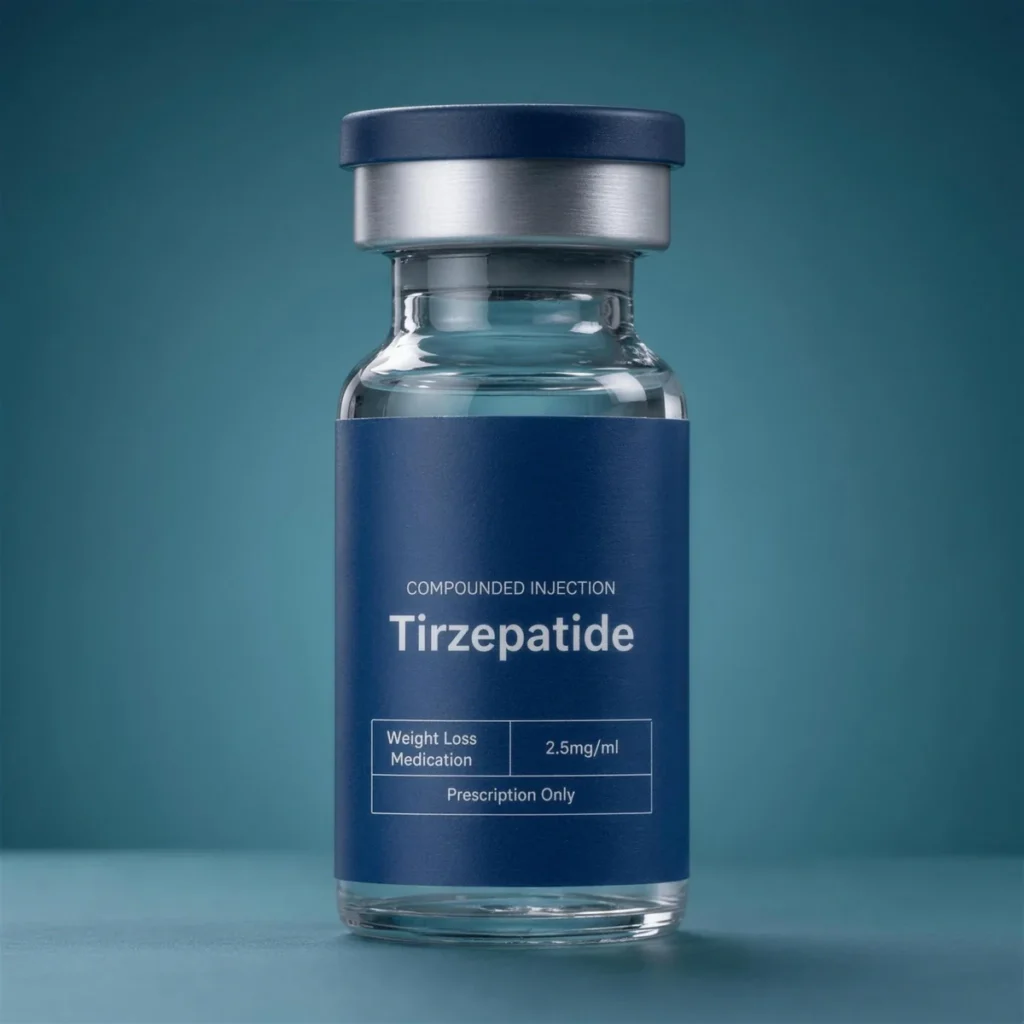
The starting dose of compounded tirzepatide is 2.5 mg once weekly, held for at least four weeks before any increase. That figure comes straight from the FDA-approved prescribing information for branded tirzepatide, and reputable prescribers apply the same titration schedule to compounded preparations. The number that changes between pharmacies is not the dose. It is the concentration of the vial, which determines how much liquid contains that 2.5 mg. Below we walk through where the starting dose comes from, why the schedule climbs slowly, what the first weeks actually feel like, how doses map to real weight loss data, and what to ask your pharmacy before you draw a single injection.
What Is the Starting Dose of Compounded Tirzepatide?
The starting dose of compounded tirzepatide is 2.5 mg injected under the skin once per week, maintained for a minimum of four weeks. That initiation dose exists to let your body meet the medication gradually, not to produce weight loss on its own. According to the FDA-approved prescribing information for tirzepatide, 2.5 mg is classified as a treatment-initiation dose and is specifically not intended for glycemic control or as a maintenance dose for weight management.
Treatment initiation follows the same four rules regardless of which formulation you receive. You inject once weekly, on the same day each week, at any hour of the day, with or without food. Tirzepatide has a half-life of roughly five days, so the once-weekly rhythm keeps blood levels steady between doses rather than spiking and crashing.
Steady blood levels matter because tirzepatide works on two hormone pathways at once. It acts as a dual agonist at the glucose-dependent insulinotropic polypeptide (GIP) receptor and the glucagon-like peptide-1 (GLP-1) receptor. Most other injectable weight loss medications engage only the GLP-1 pathway. That dual action is why we spend real time on titration with every patient starting GLP-1 weight loss treatment.
What Is Compounded Tirzepatide?
Compounded tirzepatide is a custom-prepared version of tirzepatide made by a licensed compounding pharmacy under a prescription, rather than manufactured and packaged by the drug’s original maker. Compounded preparations are not FDA-approved. The FDA does not review them for safety, effectiveness, or quality the way it reviews Zepbound and Mounjaro, the two branded tirzepatide products.
Regulatory status here has shifted substantially. Tirzepatide was placed on the FDA drug shortage list in 2022 and removed from it in December 2024. Removal from the shortage list ended the broad legal basis that allowed pharmacies to prepare compounded copies. On April 30, 2026, the FDA went further and proposed excluding semaglutide, tirzepatide, and liraglutide from the 503B Bulk Drug Substances List, finding no clinical need for outsourcing facilities to compound them from bulk substances while approved products are available. Today, compounded tirzepatide may generally be prepared only for a documented patient-specific need that the approved product cannot meet, such as a verified allergy to an inactive ingredient.
Patient-specific preparation produces one practical consequence that matters more than any other for dosing. Compounded tirzepatide arrives as a multi-dose vial, not as a pre-filled pen. You draw each dose yourself with a syringe. Concentration of that vial varies by pharmacy, and a single pharmacy may offer several concentrations. Some formulations also include added ingredients such as vitamin B12, glycine, or niacinamide.
How Many mL Is 2.5 mg of Tirzepatide?
There is no single answer for how many mL equals 2.5 mg of tirzepatide, because the volume depends entirely on the concentration of your specific vial. A vial labeled 5 mg/mL requires a different draw than one labeled 10 mg/mL for the identical 2.5 mg dose. The milligram figure is fixed by your prescription. The milliliter figure is set by the product in your hand.
This is the single most important paragraph in this article, so we will be direct about why. The FDA issued a safety alert in July 2024 documenting adverse events from dosing errors with compounded injectable products in this drug class. In most of the reported cases, patients had withdrawn more than the prescribed amount, in some instances five to twenty times the intended dose. The agency attributed the errors to two causes: patients who lacked experience withdrawing medication from a vial into a syringe, and prescribers who miscalculated when converting milligrams into units or milliliters. Reported consequences included severe nausea and vomiting, dehydration, fainting, gallstones, acute pancreatitis, and hospitalization.
Hospitalization from a conversion error is preventable, and prevention comes from a single habit. Never take a conversion chart from a website, a forum, or a friend’s vial and apply it to your own. Your dispensing pharmacy must give you the exact volume for your exact vial in writing, along with a syringe sized correctly for that volume. If those instructions are unclear, stop and call the pharmacy before injecting. The FDA specifically recommends that prescribers and compounders supply an appropriate syringe and counsel the patient on measuring the dose with it.
Why Does Tirzepatide Start at Such a Low Dose?
Tirzepatide starts at a low dose because its side effects are dose-dependent, and a gradual introduction gives the digestive system time to adapt. The gastrointestinal tract absorbs the largest share of the adjustment. Nausea, diarrhea, vomiting, constipation, abdominal pain, and indigestion all appear in the prescribing information as reactions reported by at least one in twenty patients.
Digestive adjustment happens because tirzepatide slows gastric emptying, keeping food in the stomach longer. Slower emptying is the mechanism that produces fullness on smaller portions, and it is also the mechanism that produces nausea when it arrives too abruptly. Starting at 2.5 mg lets that slowdown establish itself over four weeks rather than overnight.
The same logic governs every subsequent step. Symptoms tend to reappear briefly after each dose increase and then settle again, which is why the schedule builds in four-week intervals rather than weekly ones. Patients who understand this pattern in advance tend to ride out the first week after each increase instead of abandoning treatment. The receptor pathways behind weight loss injections explain the rest of the mechanism in more depth.
What Happens in the First Week of Taking Tirzepatide?
In the first week of taking tirzepatide, most people notice reduced appetite and earlier fullness at meals, with mild digestive symptoms that peak in the first few days after the injection. Appetite change is often the earliest signal. Research published in Diabetes in 2023 found participants reporting decreased food intake as early as one week into treatment, with more pronounced reductions in hunger and cravings developing between weeks three and eight.
Cravings fade before the scale moves for most people. That gap catches patients off guard, so here is the realistic sequence across the initiation month at 2.5 mg weekly:
- Week one. Appetite drops noticeably. Mild nausea, fatigue, or loose stools may appear within one to three days of the injection and then ease.
- Week two. Portion sizes shrink without much effort. Digestive symptoms usually soften compared with week one.
- Week three. Eating patterns start to feel routine rather than forced. Some early weight change may show, though it is often modest.
- Week four. The initiation period closes. Your provider reviews tolerance and response before deciding whether to move to 5 mg.
A four-week review is not a formality. It is the checkpoint where we decide whether your body is ready for more medication or whether holding steady serves you better.
Will 2.5 mg of Tirzepatide Help Me Lose Weight?
2.5 mg of tirzepatide will produce some weight loss for some people, but it is an initiation dose rather than a therapeutic dose, so significant loss at this level is uncommon. The prescribing information lists the maintenance doses for weight management as 5 mg, 10 mg, or 15 mg weekly. The 2.5 mg step is not on that list.
Maintenance doses carry the outcome data. A pooled analysis of seven trials published in Endocrine in 2024 found average body weight reductions of 7.5 kg at 5 mg, 11.0 kg at 10 mg, and 11.5 kg at 15 mg. No comparable figure exists for 2.5 mg because trials treated it as a ramp, not a destination.
Treating the ramp as a destination is a common early frustration. Patients sometimes conclude in week three that the medication is not working, when in fact they have not yet reached a dose designed to work. Medication is also only one input. Our medical weight loss program pairs the prescription with behavior work and mindful eating, because the drug reduces appetite while habits determine what happens to the appetite that remains.
Is It Safe to Stay on 2.5 mg Tirzepatide for Weight Loss?
Staying on 2.5 mg tirzepatide is safe when your provider agrees the dose is meeting your goals, though most patients need to escalate because 2.5 mg rarely produces meaningful weight loss on its own. The governing principle is the lowest effective dose. Nobody needs to reach 15 mg to succeed, and pushing past a dose that is already working adds side effect burden without adding benefit.
Two questions decide whether you hold or climb at each four-week review. Are you still having side effects that interfere with daily life? Are you losing weight at a reasonable pace? A yes to the second question usually means holding. A no to both usually means increasing by one step.
Here in Lee’s Summit we run those reviews in person or by text, phone, or message, whichever fits your schedule, and you see the same people throughout your care rather than a rotating panel. Continuity matters for dose decisions, because the person adjusting your dose should remember how you responded to the last one. Whether the medication suits you at all is a separate question, and screening for a good candidate happens before we write any prescription.
How Does the Tirzepatide Dose Escalation Schedule Work?
The tirzepatide dose escalation schedule increases the weekly dose by 2.5 mg at a time, with each step held for at least four weeks before the next increase. The full ladder runs 2.5 mg, then 5 mg, then 7.5 mg, then 10 mg, then 12.5 mg, then 15 mg. Nobody skips rungs, and nobody advances early.
Advancing on schedule produces the following timeline for a patient who climbs every available step.
| Week | Weekly Dose | What Happens at This Stage |
|---|---|---|
| 1 to 4 | 2.5 mg | Treatment initiation. Not a maintenance dose. Body adapts to slowed gastric emptying. |
| 5 to 8 | 5 mg | First maintenance dose. Meaningful weight loss becomes measurable for many patients. |
| 9 to 12 | 7.5 mg | Intermediate step. Used when 5 mg is tolerated but response is incomplete. |
| 13 to 16 | 10 mg | Second maintenance dose. Associated with the largest incremental gain in trial data. |
| 17 to 20 | 12.5 mg | Intermediate step toward the maximum. |
| 21 onward | 15 mg | Maximum recommended dose and the third maintenance option. |
Sources: FDA-approved prescribing information for tirzepatide; Qin et al., Endocrine, 2024.
Read the table as a ceiling on speed, not a schedule you are obligated to complete. Many patients settle at 5 mg or 10 mg and stay there for the duration of treatment.
Why Slow Dose Increases Matter
Slow dose increases matter because side effect severity rises with dose, and moving up before the body has adapted stacks a new adjustment on top of an unfinished one. Four weeks is the minimum interval in the prescribing information, and there is no clinical advantage to treating it as a target rather than a floor.
Floors can be extended. If nausea is still meaningful at the end of week four, holding the current dose for another four weeks is a normal, appropriate decision rather than a setback. Patients who hold when they need to hold generally reach their effective dose sooner than patients who push, tolerate poorly, and then stop treatment altogether. Adherence beats speed over any timeframe that matters.
Is 5 mg Tirzepatide a Microdose, and Is There a Microdosing Chart?
5 mg of tirzepatide is not a microdose, and no legitimate microdosing chart for tirzepatide exists. 5 mg is one of the three recognized maintenance doses for weight management in the FDA-approved prescribing information, alongside 10 mg and 15 mg. Calling it a microdose misreads the label.
Microdosing as a concept has no place in tirzepatide’s approved dosing framework. The prescribing information defines six specific dose levels and a fixed escalation interval. Charts circulating online that propose fractional or off-schedule dosing are not derived from clinical trial data, and following one means departing from the only regimen with published safety and efficacy evidence behind it.
Departing from that regimen also compounds the conversion problem. Fractional doses require drawing very small volumes from a vial whose concentration may already be unfamiliar, which is precisely the scenario the FDA identified behind five-to-twentyfold overdoses. We do not use microdosing protocols, and we would encourage anyone offered one to ask what published evidence supports it.
What Is the Maximum Dose of Tirzepatide?
The maximum recommended dose of tirzepatide is 15 mg once weekly. No approved indication calls for going above it. For type 2 diabetes, the maintenance range runs from 5 mg to 15 mg weekly in 2.5 mg increments based on blood sugar control. For obstructive sleep apnea in adults with obesity, the approved maintenance doses are 10 mg or 15 mg weekly.
Weight management uses the widest maintenance range of the three, which is why individual response drives the decision more than any protocol. Reaching the maximum is not a goal and not a marker of doing the program correctly. Trial data show diminishing returns at the top of the ladder, a point the outcome figures make plainly. Anyone starting GLP-1 therapy with us gets that framing on day one, because expecting to end at 15 mg sets people up to view a working dose as a failure.
How Much Weight Should I Lose on 5 mg of Tirzepatide?
On 5 mg of tirzepatide, the pooled trial data show an average body weight reduction of approximately 7.5 kg, which is roughly 16 pounds. That figure comes from the 2024 meta-analysis in Endocrine covering seven trials. Moving to 10 mg raised the average to 11.0 kg, and 15 mg raised it only marginally further to 11.5 kg.
The small gap between 10 mg and 15 mg is the most useful number on this page for setting expectations. Across those seven trials, the dose delivering the most meaningful weight change relative to its side effect burden was 10 mg weekly, not the maximum.
Longer trials produced larger figures. In SURMOUNT-1, published in the New England Journal of Medicine in 2022, adults with obesity taking 15 mg weekly for 72 weeks lost an average of 22.5% of their body weight, and about 57% of that group lost at least 20%. Those results came from participants also following a reduced-calorie diet and increased physical activity, and individual results vary considerably. A 2025 head-to-head comparison in the same journal found roughly 20% average loss at 72 weeks, with about eight in ten participants losing at least 10% of body weight.
How Long Does It Take to Lose 20 lbs on Tirzepatide?
Losing 20 lbs on tirzepatide typically takes somewhere between three and six months, depending on your starting weight, the dose you reach, and how consistently you pair the medication with dietary and activity changes. Weight loss on this medication is not linear. It tends to accelerate after you pass 2.5 mg and reach a maintenance dose.
Timeline arithmetic follows from the escalation schedule. A patient who spends four weeks at 2.5 mg and four weeks at 5 mg has only been at a therapeutic dose for one month by week eight. Meaningful cumulative loss usually becomes visible somewhere between months three and four, which lines up with the pattern we see in our own lose weight on tirzepatide discussion.
How Many Pounds Should I Lose in 3 Months on Tirzepatide?
In three months on tirzepatide, a common range is 10 to 25 pounds, though the spread across individuals is wide. Three months covers roughly the first twelve weeks, which for most patients means four weeks at 2.5 mg followed by eight weeks across the 5 mg and 7.5 mg steps.
Higher starting weights generally produce larger absolute losses in the same period, which is why percentage of body weight is the more useful measure than pounds. Trials report outcomes as percentages for exactly that reason.
Is It Normal to Lose a Pound a Day on Tirzepatide?
Losing a pound a day on tirzepatide is not normal and is not a safe pace to sustain. A pound a day works out to roughly 30 pounds a month, well beyond the trajectory seen in clinical trials even at maximum dose. Sustained loss at that speed usually signals that calorie intake has fallen far too low, often because appetite suppression has removed the hunger cue that would normally prompt eating.
Very low intake carries costs that the scale hides. Rapid loss increases the share of weight coming from lean muscle rather than fat, and it raises the risk of gallstones, a known concern with this drug class that rises alongside the speed of weight reduction. Fatigue and hair thinning also track with inadequate calorie and protein intake.
Tell your provider if you are losing faster than about one to two pounds per week. The correct response is usually a nutrition adjustment rather than stopping the medication, and getting enough protein is central to it. Knowing what to eat makes eating enough far easier during the weeks when hunger has gone quiet.
Why Am I Not Losing Weight on Tirzepatide?
The most common reason people are not losing weight on tirzepatide is that they have not yet reached a therapeutic maintenance dose, since 2.5 mg is an initiation dose that produces little weight change on its own. Before troubleshooting anything else, check where you sit on the ladder and how long you have been there.
Dose position explains most early plateaus. After that, four factors account for the majority of stalls: calorie intake that has crept back up as side effects faded, protein intake too low to preserve muscle, missed or delayed injections that let blood levels drop, and an expectation curve that is simply ahead of the biology.
Plateaus later in treatment behave differently. As body weight falls, so does the number of calories required to maintain it, meaning the intake that produced loss at the start may match maintenance needs by month six. That arithmetic is not a failure of the medication. It is a signal to revisit intake and activity with your provider rather than to escalate the dose reflexively.
What Should I Avoid While Taking Tirzepatide?
While taking tirzepatide, you should avoid relying on oral contraceptives alone, avoid combining it with other GLP-1 medications, and avoid undergoing anesthesia without telling your surgical team you take it. Each of these traces back to the same mechanism: slowed gastric emptying changes how the body handles anything that passes through the stomach.
The specific items to manage or disclose:
- Oral birth control. The prescribing information advises adding a barrier method or switching to a non-oral method for four weeks after starting tirzepatide and for four weeks after each dose increase.
- Other GLP-1 or dual agonist medications. These are not combined with tirzepatide.
- Insulin and sulfonylureas. Pairing these raises hypoglycemia risk, and doses of the other medication often need lowering with close blood sugar monitoring.
- Surgery, endoscopy, and sedation. Food retained in the stomach raises aspiration risk under anesthesia, so tell your surgeon and anesthesiologist and expect that a pause may be advised.
- Large, high-fat meals around injection day. These reliably worsen nausea during escalation weeks.
- Skipping meals entirely. Low intake accelerates muscle loss and fatigue rather than accelerating fat loss.
Pregnancy is a separate matter rather than a caution. Tirzepatide is contraindicated in pregnancy, and it carries a boxed warning for thyroid C-cell tumors observed in rodent studies, making it contraindicated for anyone with a personal or family history of medullary thyroid carcinoma or Multiple Endocrine Neoplasia syndrome type 2.
Does Tirzepatide Burn Fat or Just Suppress Appetite?
Tirzepatide primarily suppresses appetite and slows gastric emptying rather than burning fat directly, and the fat loss that follows comes from the resulting calorie deficit. Its secondary effects on glucose metabolism through the GIP pathway support how the body handles blood sugar after meals, but no mechanism in the drug oxidizes fat on its own.
Calorie deficit is the operative mechanism, and that has one important implication. Weight lost in a deficit includes both fat and lean muscle, and the proportion depends heavily on protein intake and resistance training. Patients who eat adequate protein and lift keep substantially more muscle than patients who simply eat less of everything.
Muscle preservation shapes the final result more than most people expect. Losing 30 pounds with muscle intact looks and functions differently from losing 30 pounds with a large share coming from lean tissue, even at the same number on the scale. Some patients pair treatment with slimming shots or strength work to support the composition side of the equation.
Can Tirzepatide Reduce Belly Fat?
Tirzepatide reduces belly fat as part of overall body fat reduction, though it does not target the abdomen specifically. No medication directs fat loss to a chosen region. What the trial data do show is that abdominal and visceral fat respond well when total body fat falls, and waist circumference reductions consistently accompany weight loss in tirzepatide studies.
Visceral fat, the deeper fat surrounding the abdominal organs, is the more clinically meaningful target. It is the fat most strongly linked to blood pressure, cholesterol, and blood sugar problems, and reductions in it explain much of why the cardiometabolic markers in these trials improve alongside the weight. Patients who want contour work sometimes add body sculpting once their weight has stabilized.
Loose skin sometimes follows substantial abdominal loss, particularly after larger reductions. Skin laxity is a separate concern from the fat itself, and loose skin after significant weight loss responds to its own set of treatments.
Is Tirzepatide Stronger Than Ozempic?
Tirzepatide produces greater average weight loss than semaglutide, the active ingredient in Ozempic, in head-to-head trial data. A 2025 comparison published in the New England Journal of Medicine found tirzepatide participants losing approximately 20% of body weight at 72 weeks, with around eight in ten losing at least 10%.
The mechanism explains the gap. Semaglutide is a GLP-1 receptor agonist acting on one pathway. Tirzepatide engages both the GLP-1 and GIP receptors, and the added GIP activity contributes to improved post-meal glucose handling and appears to enhance the overall metabolic effect.
Greater average effect does not make tirzepatide the right choice for everyone. Tolerance differs between individuals, insurance coverage differs between products, and some patients respond well to semaglutide with fewer digestive symptoms. We compare semaglutide results separately for anyone weighing the two.
How Long Can You Stay on Tirzepatide?
You can stay on tirzepatide long term, and current clinical thinking treats it as ongoing therapy for a chronic condition rather than a short course. Obesity behaves like other chronic conditions in this respect. Removing the treatment generally removes the effect.
Chronic framing changes how the decision to continue gets made. The question at month twelve is not whether you have finished, but whether the medication is still delivering benefit at a dose you tolerate. Trials have followed participants for 72 weeks and beyond with a consistent safety profile, and monitoring continues throughout, typically including periodic blood sugar and metabolic panels alongside weight tracking.
Long-term therapy also means the practical details compound. Consistent injection timing, a sustainable eating pattern, and regular contact with your provider matter more over years than over weeks. Patients on weekly GLP-1 injections who keep those three things steady tend to hold their results.
Can I Quit Tirzepatide Cold Turkey?
You can stop tirzepatide without a medical taper, since it produces no withdrawal syndrome, but stopping abruptly is very likely to be followed by substantial weight regain. The SURMOUNT-4 trial, published in JAMA in 2024, followed participants who switched from tirzepatide to placebo after 36 weeks. Over the following 52 weeks, they regained approximately two-thirds of the weight they had lost.
Regain arrives alongside the reversal of the metabolic gains. Improvements in blood sugar, blood pressure, and cholesterol that accompanied the weight loss tend to fade with it, which is why stopping is a decision to make deliberately rather than by drifting off the schedule.
Discuss any stopping plan before you begin rather than after you decide. Whether you taper the dose downward, transition to a different approach, or increase the intensity of the behavioral side, having that conversation in advance produces better outcomes than an unplanned stop. Appetite returns within weeks once the medication clears.
Can You Switch From Compounded Tirzepatide to Zepbound?
You can switch from compounded tirzepatide to Zepbound, and your prescriber determines the equivalent dose based on where you currently sit on the escalation ladder. Because both use the same active ingredient and the same milligram schedule, the transition is usually a matter of matching your current weekly dose to the corresponding branded strength.
What changes is the delivery format, and that change is worth preparing for. Compounded preparations come as multi-dose vials you draw with a syringe. Zepbound is available as single-dose pre-filled pens and single-dose vials, each containing a fixed amount. Switching removes the measurement step entirely, which eliminates the conversion risk described earlier in this article.
Coverage has also shifted. Insurance coverage for branded tirzepatide for weight management has broadened compared with a few years ago and varies by plan and indication, while compounded preparations are rarely covered. Ask your provider to check your specific plan before assuming either way.
Frequently Asked Questions
What Day Does Tirzepatide Peak?
Tirzepatide peaks in the blood roughly one to three days after injection, and its half-life of about five days keeps levels relatively steady across the full week. Many patients notice appetite suppression is strongest in the first few days after their injection and softens slightly before the next dose.
How Long Does It Take for Tirzepatide to Start Working?
Tirzepatide starts working within the first week for appetite, with research reporting decreased food intake as early as seven days in. Noticeable weight change usually takes longer, commonly appearing once you reach a maintenance dose of 5 mg or higher around week five to eight.
Does Compounded Tirzepatide Expire?
Compounded tirzepatide expires, and it carries a beyond-use date rather than the longer expiration date printed on commercially manufactured products. Beyond-use dates for compounded preparations are typically much shorter and are set by the preparing pharmacy. Check the date printed on your vial label and do not use the product past it.
How Should You Store Compounded Tirzepatide?
Store compounded tirzepatide in the refrigerator, and never freeze it. Inspect the vial before each use and do not inject if the liquid is discolored, cloudy, or contains particles, or if the vial is damaged. Storage instructions can differ between pharmacies, so follow the specific directions on your label.
Why Is Tirzepatide Compounded With B12?
Tirzepatide is sometimes compounded with vitamin B12 on the stated rationale that B12 may help with fatigue or nausea, though this combination is not part of any FDA-approved product and has not been tested in clinical trials for that purpose. Ask your pharmacy exactly what is in your formulation before starting, since added ingredients also affect concentration.
What Is the Difference Between Mounjaro and Zepbound?
The difference between Mounjaro and Zepbound is the approved indication, not the active ingredient. Both contain tirzepatide. Mounjaro is approved for blood sugar control in adults with type 2 diabetes, while Zepbound is approved for chronic weight management and for obstructive sleep apnea in adults with obesity.
How Do You Manage Tirzepatide Side Effects?
You manage tirzepatide side effects mainly by eating smaller and more frequent meals, limiting high-fat foods around injection day, staying well hydrated, and holding your current dose longer when symptoms persist past week four. Most digestive symptoms are mild and settle within a few weeks. Contact your provider promptly for severe or persistent abdominal pain, ongoing vomiting, or vision changes.
The Bottom Line
The starting dose of compounded tirzepatide is 2.5 mg once weekly for at least four weeks, and that figure holds regardless of which pharmacy prepares it. What does not hold constant is the concentration of the vial, which is why the milligram number on your prescription and the volume you draw into the syringe are two separate pieces of information. Get the second one from your dispensing pharmacy in writing, with a correctly sized syringe, every time. The escalation ladder climbs in 2.5 mg steps at four-week intervals to a maximum of 15 mg, most patients settle below that maximum, and the dose that works for you is the one worth staying on.
Dosing decisions land better with someone who knows your history and remembers how you responded to the last adjustment. At Slimming Solutions Med Spa in Lee’s Summit, we handle weight management as a supervised program rather than a prescription handoff, with lab work up front, a four-week review cadence, and the same team throughout. If you have questions about whether this treatment fits your situation, a consultation is a good place to start.
This article is for general education and is not medical advice. Compounded medications are not FDA-approved and are not reviewed by the FDA for safety, effectiveness, or quality. Individual results vary. Talk with a licensed provider about your specific situation.
![[thumb]](https://slimmingsolutionsspa.com/wp-content/uploads/2023/12/botox1-150x150.png)
![[thumb]](https://slimmingsolutionsspa.com/wp-content/uploads/2023/12/Before2-150x150.png)
![[thumb]](https://slimmingsolutionsspa.com/wp-content/uploads/2023/12/Before3-150x150.png)



![[thumb]](https://slimmingsolutionsspa.com/wp-content/uploads/2023/12/revanesse-versa-1-150x150.png)
![[thumb]](https://slimmingsolutionsspa.com/wp-content/uploads/2023/12/revanesse-versa-2-150x150.png)
![[thumb]](https://slimmingsolutionsspa.com/wp-content/uploads/2023/12/revanesse-versa-3-150x150.png)
![[thumb]](https://slimmingsolutionsspa.com/wp-content/uploads/2023/12/revanesse-versa-4-150x150.png)
![[thumb]](https://slimmingsolutionsspa.com/wp-content/uploads/2023/12/revanesse-versa-5-150x150.png)
![[thumb]](https://slimmingsolutionsspa.com/wp-content/uploads/2024/01/Eyebrow-treatment-1-1-150x150.png)
![[thumb]](https://slimmingsolutionsspa.com/wp-content/uploads/2023/12/Skin-Rejuvenation-1-150x150.png)
![[thumb]](https://slimmingsolutionsspa.com/wp-content/uploads/2023/12/Skin-Rejuvenation-2-150x150.png)


![[thumb]](https://slimmingsolutionsspa.com/wp-content/uploads/2024/01/Lip-Filler-1-150x150.png)
![[thumb]](https://slimmingsolutionsspa.com/wp-content/uploads/2024/01/Lip-Filler-2-150x150.png)
![[thumb]](https://slimmingsolutionsspa.com/wp-content/uploads/2025/02/Lip-Filler-1-150x150.png)
![[thumb]](https://slimmingsolutionsspa.com/wp-content/uploads/2024/01/Lip-Filler-150x150.jpg)
![[thumb]](https://slimmingsolutionsspa.com/wp-content/uploads/2024/01/Before-1-150x150.jpg)

![[thumb]](https://slimmingsolutionsspa.com/wp-content/uploads/2024/01/RHA-Treatmetn-3-150x150.png)
![[thumb]](https://slimmingsolutionsspa.com/wp-content/uploads/2024/01/RHA-Treatmetn-2-150x150.png)
![[thumb]](https://slimmingsolutionsspa.com/wp-content/uploads/2024/01/RHA-Treatmetn-1-150x150.png)
![[thumb]](https://slimmingsolutionsspa.com/wp-content/uploads/2024/01/Thread-Lifts-1-150x150.png)
![[thumb]](https://slimmingsolutionsspa.com/wp-content/uploads/2024/01/Thread-Lifts-2-150x150.png)
![[thumb]](https://slimmingsolutionsspa.com/wp-content/uploads/2025/02/Lip-Filler-2-150x150.png)

![[thumb]](https://slimmingsolutionsspa.com/wp-content/uploads/2023/12/skin-reuvulation1-150x150.png)
![[thumb]](https://slimmingsolutionsspa.com/wp-content/uploads/2023/12/skin-rejuvulation-2-150x150.png)
![[thumb]](https://slimmingsolutionsspa.com/wp-content/uploads/2023/12/Skin-Tighting-150x150.png)
![[thumb]](https://slimmingsolutionsspa.com/wp-content/uploads/2023/12/Before-150x150.jpg)
![[thumb]](https://slimmingsolutionsspa.com/wp-content/uploads/2023/12/weightloss-1-150x150.png)
![[thumb]](https://slimmingsolutionsspa.com/wp-content/uploads/2023/12/weightloss-2-150x150.png)
![[thumb]](https://slimmingsolutionsspa.com/wp-content/uploads/2023/12/2Weight-Loss-2-150x150.png)
![[thumb]](https://slimmingsolutionsspa.com/wp-content/uploads/2025/02/Weight-Loss-1-new-150x150.png)
![[thumb]](https://slimmingsolutionsspa.com/wp-content/uploads/2023/12/Weight-Loss-3-150x150.png)
![[thumb]](https://slimmingsolutionsspa.com/wp-content/uploads/2025/03/Slimming-Solutions-BA-Template-150x150.png)


![[thumb]](https://slimmingsolutionsspa.com/wp-content/uploads/2023/12/dat3-150x150.png)
![[thumb]](https://slimmingsolutionsspa.com/wp-content/uploads/2023/12/dat-0-150x150.png)
![[thumb]](https://slimmingsolutionsspa.com/wp-content/uploads/2023/12/dat-1-150x150.png)
![[thumb]](https://slimmingsolutionsspa.com/wp-content/uploads/2023/12/Before-1-150x150.png)

![[thumb]](https://slimmingsolutionsspa.com/wp-content/uploads/2024/01/EMS-Treatment-2-150x150.png)
![[thumb]](https://slimmingsolutionsspa.com/wp-content/uploads/2024/01/EMS-Treatment-1-150x150.png)
![[thumb]](https://slimmingsolutionsspa.com/wp-content/uploads/2025/02/ems-BNA-front-150x150.png)
![[thumb]](https://slimmingsolutionsspa.com/wp-content/uploads/2025/02/EMS-bna-SIDE-150x150.png)
![[thumb]](https://slimmingsolutionsspa.com/wp-content/uploads/2024/01/EMS-Treatment-6-150x150.png)