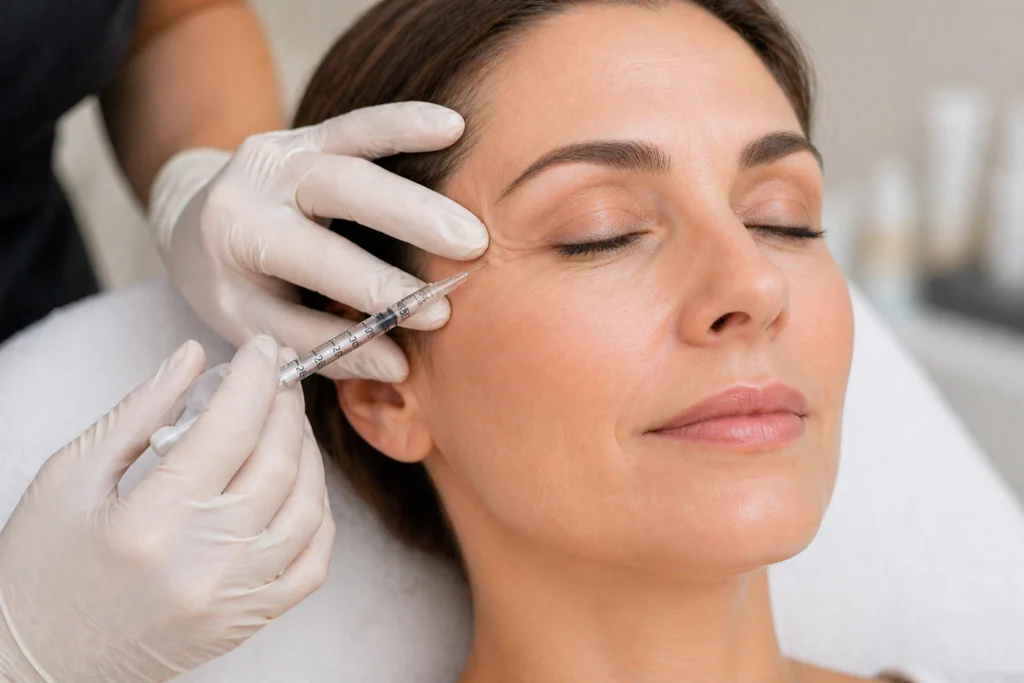

Yes, you can take Tylenol after Botox. Acetaminophen, the active ingredient in Tylenol, is the pain reliever most injectors recommend, because unlike ibuprofen and aspirin it does not affect how your blood clots. That distinction is the whole answer to this question. What you want to avoid for about 24 hours are the NSAIDs: ibuprofen, Advil, Motrin, naproxen, Aleve, and aspirin, all of which make bruising at injection sites more likely. Below we cover each of those by name, flag a combination product that catches people out, explain the one drug interaction that appears on the actual Botox label, and answer the sedating-medication and hot-bath questions that come up alongside.
Can I Take Tylenol After Botox?
You can take Tylenol after Botox at any point, including the same day, and it is the pain reliever most providers suggest. Nothing about acetaminophen interferes with the product, the injection sites, or your results.
The reason comes down to platelets. Aspirin and NSAIDs inhibit platelet function, which is how they reduce inflammation but also why they increase bleeding and bruising. Acetaminophen works through a different mechanism and has no meaningful antiplatelet effect, so it relieves a headache without raising your chances of a mark under the skin.
Most people do not need anything at all. Botox injections involve a very fine needle and a handful of quick placements, and discomfort afterward is usually mild and short. Tylenol is there for the occasional post-treatment headache rather than as a standard part of aftercare.
Discomfort during the appointment is a separate worry, and anyone weighing whether does Botox hurt will find that most patients describe it as a brief pinch.
What Pain Reliever Can You Take After Botox?
Acetaminophen is the pain reliever to take after Botox, and NSAIDs including ibuprofen, naproxen, and aspirin are the ones to avoid for roughly 24 hours. The split is clean and it follows a single principle: does the medication affect clotting.
Here is how the products people actually reach for sort out.
| Medication | After Botox | Why |
|---|---|---|
| Tylenol (acetaminophen) | Yes, any time | No antiplatelet effect, does not increase bruising |
| Ibuprofen (Advil, Motrin) | Wait 24 hours | NSAID, inhibits platelet function |
| Naproxen (Aleve) | Wait 24 hours | NSAID, longer-acting than ibuprofen |
| Aspirin | Wait 24 hours | Strongest antiplatelet effect of the group |
| Excedrin Extra Strength or Migraine | Wait 24 hours | Contains aspirin alongside acetaminophen |
| Excedrin Tension Headache | Yes | Aspirin-free, acetaminophen and caffeine only |
| Benadryl (diphenhydramine) | Yes, with one caveat | No clotting effect, but it causes drowsiness |
| NyQuil | Yes, with one caveat | Contains acetaminophen, but it is sedating |
| Melatonin | Yes, with one caveat | No clotting effect, but it is sedating |
| Antibiotics | Tell your injector first | One class carries a labeled interaction |
| Prescription medications | Tell your injector and prescriber | Depends entirely on the medication |
Sources: FDA prescribing information for Botox Cosmetic; DailyMed product labeling for Excedrin Extra Strength and Excedrin Tension Headache; Cleveland Clinic.
The last three rows are where most articles stop short, and they are covered in full further down.
Can You Take Ibuprofen After Botox?
Wait about 24 hours before taking ibuprofen after Botox, unless a doctor has told you to take it. Ibuprofen is a nonsteroidal anti-inflammatory drug, and Cleveland Clinic lists it alongside aspirin and naproxen as medications that can promote bruising.
The risk is a cosmetic one rather than a safety one. Taking ibuprofen the evening after treatment will not harm you or ruin your results. It raises the chance of a visible bruise at an injection site, which matters if you have plans that week. Small bruises are the most common side effect of injections in any case, and a few sensible steps can reduce swelling and marking in the first hours.
Can You Take Advil, Motrin, Aleve, or Aspirin After Botox?
All four fall under the same 24-hour guidance, because all four are NSAIDs. Advil and Motrin are both ibuprofen under different brand names. Aleve is naproxen, which stays in your system longer than ibuprofen. Aspirin has the strongest and longest-lasting antiplatelet effect of the group.
Aspirin deserves a longer window before treatment than after. Its effect on platelets lasts for the life of the platelet rather than clearing with the drug, which is why many injectors ask patients to stop non-essential aspirin several days beforehand rather than the night before. That is a before-treatment consideration, not an after-treatment one.
Can You Take Excedrin After Botox?
It depends which Excedrin you have, because some formulations contain aspirin and at least one does not. This catches people out constantly, and it is the most practically useful thing on this page.
Excedrin Extra Strength contains acetaminophen 250 mg, aspirin 250 mg, and caffeine 65 mg per caplet, and the label itself flags the aspirin as an NSAID. So does Excedrin Migraine. A patient who has been told to avoid aspirin and then reaches for Excedrin has taken aspirin without knowing it.
Excedrin Tension Headache is the exception. It is labeled aspirin-free and contains only acetaminophen and caffeine, which puts it in the same category as plain Tylenol for our purposes.
Two products, same brand, opposite answers. That is the whole argument for reading the label rather than trusting the box.
How to Check a Label Before You Take Something
Turn the box over and read the active ingredients panel rather than the front. Look for:
- Aspirin, sometimes listed as acetylsalicylic acid or ASA.
- Ibuprofen, the active ingredient in Advil and Motrin.
- Naproxen or naproxen sodium, the active ingredient in Aleve.
- The letters NSAID, which labels are required to display next to these ingredients.
- Salicylate in any form, including in some topical products.
- Acetaminophen, which is the one you are looking for rather than avoiding.
Combination cold, flu, sinus, and headache products are where NSAIDs hide most often. If a product treats several symptoms at once, it almost certainly contains more than one active ingredient, and one of them may be an NSAID.
Do Not Stop a Prescribed Medication for Your Appointment
If a doctor has prescribed aspirin, an NSAID, or a blood thinner, do not stop taking it before or after Botox without that doctor’s direction. This is the most important thing in this article and it runs in the opposite direction from everything else.
Low-dose aspirin taken for cardiovascular protection, prescribed NSAIDs for arthritis or another chronic condition, and anticoagulants like warfarin or the newer oral agents all exist for reasons that outweigh a cosmetic bruise by an enormous margin. Stopping one to get a better result from an elective treatment is the wrong trade, and it is not a decision an injector should be making for you.
Tell your injector instead. We ask every patient at our Lee’s Summit office for a full medication list before treatment, including over-the-counter products and supplements, and a patient on a blood thinner simply gets a slightly different conversation about bruising expectations rather than being asked to change their medication. If you and your prescribing physician decide together that a brief pause is appropriate, that is a different situation entirely.
Can You Take Tylenol or Ibuprofen Before Botox?
You can take Tylenol before Botox, and you should avoid NSAIDs beforehand for the same reason you avoid them afterward. The before-treatment window actually matters more than the after-treatment one.
Timing beforehand carries more weight because a bruise forms at the moment a needle nicks a small vessel. The state of your platelets during the appointment is what determines whether that happens, so an NSAID taken the morning of treatment is more consequential than one taken that evening.
A workable timeline for anyone who bruises easily:
- Seven to ten days before: discuss stopping non-essential aspirin with your doctor, since its platelet effect is the longest-lasting.
- Three to five days before: pause optional fish oil, high-dose vitamin E, and similar supplements.
- Two to three days before: stop non-essential ibuprofen, naproxen, and other NSAIDs.
- The day before: skip alcohol, which dilates blood vessels and thins the blood slightly.
- The morning of: eat normally, hydrate, and take Tylenol if you need something.
- After treatment: Tylenol as needed, NSAIDs after 24 hours.
None of this is mandatory, and plenty of patients skip all of it and bruise not at all. It is a set of odds-improving steps rather than requirements. Timing your Botox appointment away from an important event gives you the same protection with less effort.
What to Take Before Botox
The honest answer is that nothing needs to be taken before Botox. There is no pre-medication, no supplement that improves the outcome, and nothing you need to buy. Arriving hydrated and well rested is the extent of it.
We do not sell or recommend supplements for this purpose. If bruising is a recurring problem for you, that is worth raising with your injector, because technique and needle choice influence it more than anything you could take.
Can You Take Antibiotics After Botox?
Tell your injector before starting or continuing an antibiotic around your Botox appointment, because one class of antibiotics carries a genuine interaction that appears on the product’s own label. Most antibiotics are not a problem. One group is.
The FDA prescribing information for Botox Cosmetic states that coadministration with aminoglycosides, or other agents that interfere with neuromuscular transmission, should only be done with caution because the effect of the toxin may be potentiated. Aminoglycosides include gentamicin, neomycin, and streptomycin. Potentiated means stronger than intended, which in this context means more muscle weakness than was planned for.
This is not a reason for alarm and it is not common. Aminoglycosides are not what a doctor typically prescribes for a sinus infection or strep throat, and most patients on antibiotics are taking something entirely unrelated to this warning. What it does mean is that “I’m on an antibiotic” is worth mentioning rather than assuming it is irrelevant, and that is true whichever of our neurotoxin treatments you are receiving.
There is a separate, simpler point about being unwell. If you are running a fever or feel genuinely sick, postponing an elective cosmetic treatment until you have recovered is the sensible call regardless of what medication you are taking.
Other Medications Your Injector Should Know About
The same section of the Botox label flags three more categories. Muscle relaxants may exaggerate muscle weakness when given before or after treatment. Anticholinergic drugs taken afterward may potentiate systemic anticholinergic effects. And receiving a different botulinum toxin product within several months of another one has effects the label describes as unknown, with the potential to compound weakness.
That last point is worth knowing if you have had treatment elsewhere recently. Tell your injector when and what you received, since it affects timing rather than just curiosity. Which areas of the face were treated matters too.
For prescription medications generally, including anxiety medications, stimulants, antidepressants, and anything else you take daily, the right approach is to bring the list rather than to look up each one. Your injector reviews it, your prescribing physician knows your history, and your pharmacist can answer interaction questions with your full profile in front of them. A med spa blog is not the place to get specific guidance on a prescription drug, and any site offering it should be read with suspicion.
Can You Take Vitamins After Botox?
Most vitamins and supplements are fine after Botox, though a few have mild blood-thinning effects worth pausing before treatment rather than after. The concern is bruising, same as with NSAIDs.
The ones that come up most often are fish oil and omega-3 supplements, high-dose vitamin E, turmeric, ginkgo, garlic supplements, and ginger in supplement form. Each has a mild antiplatelet effect, and stopping optional ones a few days before treatment is a reasonable precaution.
Afterward, none of them need restricting. Once the injections are done and any bruise has either formed or not, a supplement has nothing left to influence. Resume whatever you normally take. Anything prescribed or medically necessary stays in place throughout, and that decision belongs to whoever prescribed it.
Can You Take Benadryl, NyQuil, or Melatonin After Botox?
All three are fine after Botox on the medication side, but each one makes you drowsy, and lying down within the first few hours is the thing to avoid. Nobody frames it this way, and it is the actual issue.
Look at what each contains. Benadryl is diphenhydramine, an antihistamine with no effect on clotting. NyQuil contains acetaminophen, which is the pain reliever we recommend, along with a cough suppressant and an antihistamine. Melatonin is a hormone supplement with no antiplatelet activity. On the bruising question, all three pass.
Sedation is the conflict. Cleveland Clinic advises staying upright for three to four hours after injection so the product settles where it was placed. A sleep aid taken shortly after treatment works directly against that, not because of the drug but because of what it makes you do.
Timing solves it entirely. If you need one of these, take it after the upright window has closed. A treatment appointment at 2pm and a NyQuil dose at 9pm is no conflict at all.
Can You Take a Nap After Botox?
Wait until at least four hours after treatment to nap, and sleep on your back rather than face-down when you do. The concern is not sleep itself. It is that lying flat, particularly face-down against a pillow, applies both gravity and pressure to areas where the product has not finished binding.
Sitting upright in a recliner with your head supported is generally acceptable if you are tired. Booking a morning appointment means the window closes long before you would want to lie down anyway.
Can You Take a Bath After Botox?
You can take a normal bath or shower after Botox on the same day, but skip hot baths, hot tubs, and saunas for 24 hours. Water is irrelevant. Heat is the variable.
Sustained heat raises circulation throughout the body, including through the treated area, which is the same concern that governs the exercise and sauna guidance. A hot soak holds your body temperature elevated for as long as you stay in, with no natural signal to stop.
Two more things about baths specifically. Submerging your face is worth avoiding on day one, since it usually involves wiping afterward. And a bath means lying back, which runs into the upright rule if you are within the first four hours. A warm shower, standing up, is the simplest option on treatment day.
Can I Touch My Face 4 Hours After Botox?
You can touch your face gently four hours after Botox, though avoiding pressure on the treated areas for the rest of the first day is better still. Light contact is different from rubbing.
Pressure is what the guidance addresses. Cleveland Clinic notes that the product can spread roughly half an inch when an area is massaged, and advises avoiding rubbing or massaging the treated area for around 12 hours. Brushing your hair back, resting your chin on your hand, or washing gently with fingertips are not what that means.
A useful test: if the motion would move the skin rather than just contact it, save it for tomorrow. The mechanics behind why placement is this sensitive are covered in how Botox works.
What if You Accidentally Rubbed Your Forehead After Botox?
An accidental rub is almost never a problem, and one absent-minded touch is not going to undo your treatment. The guidance exists to prevent sustained or vigorous massage, not incidental contact.
Stop, leave it alone for the rest of the day, and check the mirror tomorrow. If you notice asymmetry or a heavier feeling on one side over the following week, tell your injector, since that is worth knowing about even though it is unlikely.
Is It Okay to Put Moisturizer on After Botox?
You can apply moisturizer after Botox once four hours have passed, using a gentle patting motion rather than rubbing it in. The product itself is irrelevant. Application pressure is the whole question.
Skip active ingredients on the treated area for the first day. Retinol, glycolic acid, salicylic acid, and vitamin C serums can irritate skin around fresh injection points, and there is no benefit to using them on treatment evening. A plain moisturizer and sunscreen cover everything you need.
Makeup follows similar logic on a similar timeline, and makeup after Botox covers the application technique in more depth.
Can I Massage My Face 3 Days After Botox?
You can massage your face three days after Botox with no concern, because the product has fully bound to the muscle by then. Migration is a first-day-or-two issue, not an ongoing one.
Professional facials and facial massage wait at least 24 hours, and some injectors prefer longer for treatments involving significant manipulation. By day three you are well clear of any reasonable window.
That binding timeline is why the restrictive part of aftercare is genuinely short. A day or two of light care buys you three to four months of results, and softened fine lines develop over the following two weeks regardless.
Why Drink Lots of Water After Botox?
Drinking water after Botox supports general recovery and skin comfort, though the benefit is modest and it does not affect how well the treatment works. Worth doing, not worth overselling.
Hydration helps in ordinary ways. Well-hydrated skin is less reactive after minor needle trauma, and adequate fluid helps with the mild headache some patients notice in the hours afterward. It also offsets alcohol or caffeine if you have had either.
What water does not do is change where the product sits, how quickly it takes effect, or how long it lasts. Some sites imply otherwise. Drink normally, keep a glass nearby, and do not treat it as a results-improving intervention. For the record, coffee is fine too, as covered in drinking after Botox.
Frequently Asked Questions
What Should You Do if You Already Took Ibuprofen?
Nothing needs doing if you already took ibuprofen after Botox. Your results are not affected and no intervention is required. You may be slightly more likely to see a small bruise at an injection site. Skip further NSAID doses until 24 hours have passed and use Tylenol instead if you need something.
Can Botox Move After 6 Hours?
Botox can still move at six hours, which is why the first-day guidance runs to 24 hours rather than stopping at four. The four-hour mark covers the strictest window for posture, while pressure and vigorous massage are worth avoiding for the rest of the day. By 24 to 48 hours the product has bound and migration is no longer a realistic concern.
What if You Accidentally Sleep on Your Side After Botox?
Side sleeping after Botox is unlikely to cause a problem, particularly after the first night. Back sleeping is preferable on treatment night because face-down or side pressure lasts for hours rather than seconds. Waking up to find you rolled over is not worth worrying about.
Can You Take Tylenol With Botox Long Term?
Acetaminophen has no interaction with Botox at any point in treatment, and taking it regularly for an unrelated reason does not affect your injections. Follow the dosing directions on the package, since acetaminophen has liver-related limits that apply independently of anything cosmetic.
Can You Ice After Botox?
You can ice the treated areas after Botox, and it helps with swelling and bruising. Use a cool pack wrapped in a cloth for around ten minutes at a time, resting it lightly rather than pressing. Never apply ice directly to skin, and keep the pressure minimal so the cold does the work instead of the contact.
Does It Matter Which Neurotoxin You Received?
The medication guidance is the same across neurotoxins, since all of them are botulinum toxin products working by the same mechanism. The labeled interactions around aminoglycosides, muscle relaxants, and anticholinergics apply across the class, including Xeomin, Jeuveau, and Dysport.
Duration is the one thing that can vary between products. How long Botox lasts may differ slightly from one neurotoxin to another, but aftercare does not.
What to Remember
Tylenol is the pain reliever to reach for after Botox, and ibuprofen, Advil, Motrin, Aleve, and aspirin all wait about 24 hours because they affect clotting and raise the chance of a bruise. Read the active ingredients panel before taking any combination product, since Excedrin Extra Strength contains aspirin while Excedrin Tension Headache does not. Benadryl, NyQuil, and melatonin are all fine, but take them after the four-hour upright window rather than before it. Tell your injector about antibiotics, muscle relaxants, and any prescription medication, because one antibiotic class carries a real interaction on the label. And never stop a medication your doctor prescribed in order to improve a cosmetic result.
The simplest version of all of this is that your injector should already know what you take. At Slimming Solutions Med Spa in Lee’s Summit, we review a full medication list before treatment, and Nurse Joi has been a Level 5 certified Master Injector since 2014 using a technique built around minimizing bruising in the first place.
Questions before booking are always welcome, and a consultation is a good place to start.
This article is for general education and is not medical advice. Do not start, stop, or change any medication based on it. Talk with your prescribing physician or pharmacist about your specific medications, and tell your injector what you take before treatment.
![[thumb]](https://slimmingsolutionsspa.com/wp-content/uploads/2023/12/botox1-150x150.png)
![[thumb]](https://slimmingsolutionsspa.com/wp-content/uploads/2023/12/Before2-150x150.png)
![[thumb]](https://slimmingsolutionsspa.com/wp-content/uploads/2023/12/Before3-150x150.png)


![[thumb]](https://slimmingsolutionsspa.com/wp-content/uploads/2023/12/revanesse-versa-1-150x150.png)
![[thumb]](https://slimmingsolutionsspa.com/wp-content/uploads/2023/12/revanesse-versa-2-150x150.png)
![[thumb]](https://slimmingsolutionsspa.com/wp-content/uploads/2023/12/revanesse-versa-3-150x150.png)
![[thumb]](https://slimmingsolutionsspa.com/wp-content/uploads/2023/12/revanesse-versa-4-150x150.png)
![[thumb]](https://slimmingsolutionsspa.com/wp-content/uploads/2023/12/revanesse-versa-5-150x150.png)
![[thumb]](https://slimmingsolutionsspa.com/wp-content/uploads/2024/01/Eyebrow-treatment-1-1-150x150.png)
![[thumb]](https://slimmingsolutionsspa.com/wp-content/uploads/2023/12/Skin-Rejuvenation-1-150x150.png)
![[thumb]](https://slimmingsolutionsspa.com/wp-content/uploads/2023/12/Skin-Rejuvenation-2-150x150.png)


![[thumb]](https://slimmingsolutionsspa.com/wp-content/uploads/2024/01/Lip-Filler-1-150x150.png)
![[thumb]](https://slimmingsolutionsspa.com/wp-content/uploads/2024/01/Lip-Filler-2-150x150.png)
![[thumb]](https://slimmingsolutionsspa.com/wp-content/uploads/2025/02/Lip-Filler-1-150x150.png)
![[thumb]](https://slimmingsolutionsspa.com/wp-content/uploads/2024/01/Lip-Filler-150x150.jpg)
![[thumb]](https://slimmingsolutionsspa.com/wp-content/uploads/2024/01/Before-1-150x150.jpg)

![[thumb]](https://slimmingsolutionsspa.com/wp-content/uploads/2024/01/RHA-Treatmetn-3-150x150.png)
![[thumb]](https://slimmingsolutionsspa.com/wp-content/uploads/2024/01/RHA-Treatmetn-2-150x150.png)
![[thumb]](https://slimmingsolutionsspa.com/wp-content/uploads/2024/01/RHA-Treatmetn-1-150x150.png)
![[thumb]](https://slimmingsolutionsspa.com/wp-content/uploads/2024/01/Thread-Lifts-1-150x150.png)
![[thumb]](https://slimmingsolutionsspa.com/wp-content/uploads/2024/01/Thread-Lifts-2-150x150.png)
![[thumb]](https://slimmingsolutionsspa.com/wp-content/uploads/2025/02/Lip-Filler-2-150x150.png)

![[thumb]](https://slimmingsolutionsspa.com/wp-content/uploads/2023/12/skin-reuvulation1-150x150.png)
![[thumb]](https://slimmingsolutionsspa.com/wp-content/uploads/2023/12/skin-rejuvulation-2-150x150.png)
![[thumb]](https://slimmingsolutionsspa.com/wp-content/uploads/2023/12/Skin-Tighting-150x150.png)
![[thumb]](https://slimmingsolutionsspa.com/wp-content/uploads/2023/12/Before-150x150.jpg)
![[thumb]](https://slimmingsolutionsspa.com/wp-content/uploads/2023/12/weightloss-1-150x150.png)
![[thumb]](https://slimmingsolutionsspa.com/wp-content/uploads/2023/12/weightloss-2-150x150.png)
![[thumb]](https://slimmingsolutionsspa.com/wp-content/uploads/2023/12/2Weight-Loss-2-150x150.png)
![[thumb]](https://slimmingsolutionsspa.com/wp-content/uploads/2025/02/Weight-Loss-1-new-150x150.png)
![[thumb]](https://slimmingsolutionsspa.com/wp-content/uploads/2023/12/Weight-Loss-3-150x150.png)
![[thumb]](https://slimmingsolutionsspa.com/wp-content/uploads/2025/03/Slimming-Solutions-BA-Template-150x150.png)


![[thumb]](https://slimmingsolutionsspa.com/wp-content/uploads/2023/12/dat3-150x150.png)
![[thumb]](https://slimmingsolutionsspa.com/wp-content/uploads/2023/12/dat-0-150x150.png)
![[thumb]](https://slimmingsolutionsspa.com/wp-content/uploads/2023/12/dat-1-150x150.png)
![[thumb]](https://slimmingsolutionsspa.com/wp-content/uploads/2023/12/Before-1-150x150.png)

![[thumb]](https://slimmingsolutionsspa.com/wp-content/uploads/2024/01/EMS-Treatment-2-150x150.png)
![[thumb]](https://slimmingsolutionsspa.com/wp-content/uploads/2024/01/EMS-Treatment-1-150x150.png)
![[thumb]](https://slimmingsolutionsspa.com/wp-content/uploads/2025/02/ems-BNA-front-150x150.png)
![[thumb]](https://slimmingsolutionsspa.com/wp-content/uploads/2025/02/EMS-bna-SIDE-150x150.png)
![[thumb]](https://slimmingsolutionsspa.com/wp-content/uploads/2024/01/EMS-Treatment-6-150x150.png)