
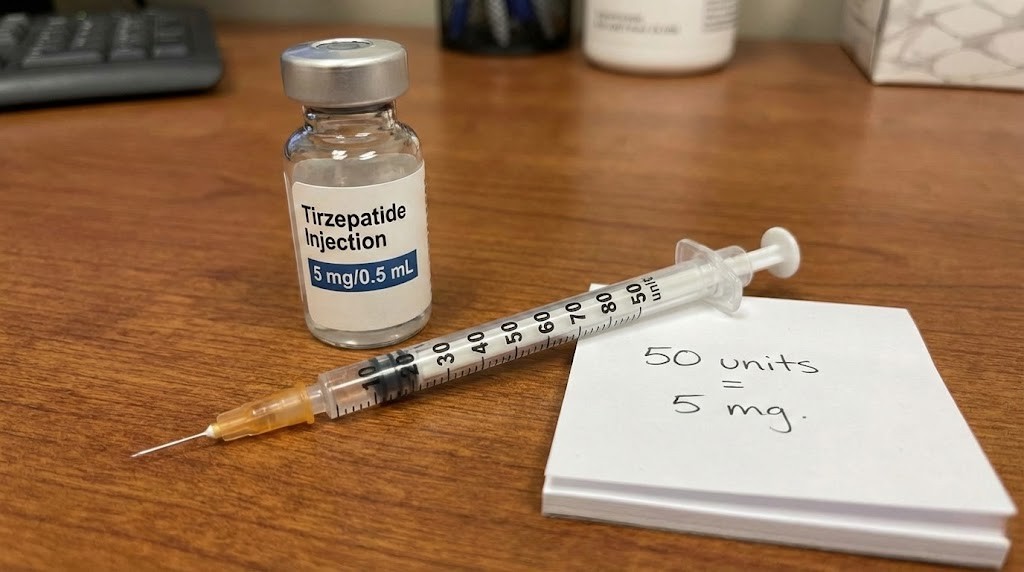
5mg of tirzepatide equals 25 units to 50 units on a U-100 insulin syringe, and the exact number depends entirely on the concentration of your vial. At 10 mg/mL, 5 mg is 50 units. At 17 mg/mL, 5 mg is about 29 units. At 20 mg/mL, 5 mg is 25 units. At 25 mg/mL, 5 mg is 20 units. One milligram dose, four different unit counts, because the concentration printed on your vial label decides how much liquid carries that 5 mg.
That concentration number is the one piece of information every unit chart depends on. Below we walk through the conversion formula, where the concentration appears on your label, what the unit markings on an insulin syringe actually measure, how 5 mg compares to the 2.5 mg step before it, and why your unit count can change even when your prescription has not.
| Vial Concentration | Volume for a 5 mg Dose | Units on a U-100 Syringe |
|---|---|---|
| 5 mg/mL | 1.0 mL | 100 units |
| 10 mg/mL | 0.5 mL | 50 units |
| 17 mg/mL | 0.29 mL | 29 units |
| 20 mg/mL | 0.25 mL | 25 units |
| 25 mg/mL | 0.20 mL | 20 units |
How Many Units Is 5mg of Tirzepatide?
5mg of tirzepatide is 50 units at a 10 mg/mL concentration, 29 units at 17 mg/mL, 25 units at 20 mg/mL, and 20 units at 25 mg/mL. The milligram dose stays fixed at 5 mg in every one of those cases. What changes is the volume of liquid that holds those 5 milligrams, and volume is exactly what the unit markings on your syringe measure.
Volume differences come from how the medication was prepared. A pharmacy that dissolves tirzepatide at 10 mg/mL puts 10 milligrams of drug into every milliliter of solution, so half a milliliter carries 5 mg. A pharmacy working at 20 mg/mL packs twice as much drug into that same milliliter, so a quarter milliliter carries the identical 5 mg. Twice the strength means half the draw.
Half the draw on a syringe barrel looks dramatically different, which is why two patients on the same prescribed dose can correctly draw 25 units and 50 units on the same morning. Neither is wrong. Each is reading the concentration on the vial actually in front of them.
How Do You Convert Tirzepatide mg to Units?
You convert tirzepatide mg to units with one formula:
Units = (Prescribed dose in mg ÷ Vial concentration in mg/mL) × 100
The formula multiplies by 100 because a U-100 insulin syringe is calibrated at 100 units per 1 mL. Each single unit on that barrel represents 0.01 mL, so once you know the volume your dose occupies, multiplying by 100 converts milliliters into syringe markings directly.
Syringe markings become easy to find once you run the numbers. At 10 mg/mL, 5 divided by 10 gives 0.5 mL, and 0.5 multiplied by 100 gives 50 units. At 20 mg/mL, 5 divided by 20 gives 0.25 mL, which converts to 25 units. At 17 mg/mL, 5 divided by 17 gives 0.294 mL, which rounds to 29 units.
Rounding comes up often at 17 mg/mL and 25 mg/mL because those concentrations rarely produce whole numbers. We cover what to do with a fractional result further down, and patients starting GLP-1 weight loss treatment with us get walked through this math in person before their first injection at home.
Where Do You Find the Concentration on Your Tirzepatide Vial?
You find the concentration on your tirzepatide vial printed on the pharmacy label, written as milligrams per milliliter. Look for a number followed by “mg/mL,” commonly shown as 10 mg/mL or 20 mg/mL. Some labels print the total content instead, such as “100 mg/5 mL,” which works out to the same 20 mg/mL once you divide.
Dividing total content by total volume gives you the concentration every time, and that single number is the only input the formula needs from you. Your prescriber supplies the other input, the milligram dose, on the prescription itself.
The prescription and the label together are the authority on your dose. A chart on a website, including the one below, is a worked example of the arithmetic rather than a statement about your medication. We tell patients to treat any chart as a way to check their own math, never as a replacement for the label in their hand. The same principle applies to all weight loss injections that arrive in vial form rather than as a fixed-dose pen.
What Is the Tirzepatide Dosing Chart in Units?
The tirzepatide dosing chart in units converts each milligram step on the standard titration ladder into syringe units at five common concentrations. The milligram column follows the schedule in the Zepbound prescribing information published by the U.S. Food and Drug Administration, which starts at 2.5 mg weekly, raises the dose by 2.5 mg no sooner than every four weeks, and caps at 15 mg weekly, with 5 mg, 10 mg, and 15 mg listed as approved maintenance doses.
| Prescribed Dose | 5 mg/mL | 10 mg/mL | 17 mg/mL | 20 mg/mL | 25 mg/mL |
|---|---|---|---|---|---|
| 2.5 mg | 50 units | 25 units | 15 units | 12.5 units | 10 units |
| 5 mg | 100 units | 50 units | 29 units | 25 units | 20 units |
| 7.5 mg | 150 units* | 75 units | 44 units | 37.5 units | 30 units |
| 10 mg | 200 units* | 100 units | 59 units | 50 units | 40 units |
| 12.5 mg | 250 units* | 125 units* | 74 units | 62.5 units | 50 units |
| 15 mg | 300 units* | 150 units* | 88 units | 75 units | 60 units |
Values marked with an asterisk exceed the 100-unit capacity of a standard 1 mL insulin syringe, which is the practical reason pharmacies move patients to a stronger concentration as the dose climbs. A result above 100 units is a signal to call your pharmacy rather than a signal to split the injection or estimate.
Why Do Tirzepatide Unit Charts Show Different Numbers?
Tirzepatide unit charts show different numbers because each chart is built for a different concentration. A chart written for a 10 mg/mL vial lists 5 mg as 50 units. A chart written for a 20 mg/mL vial lists the identical 5 mg as 25 units. Both charts are correct for the vial they describe and wrong for the other one.
Describing the vial correctly is the whole job of a unit chart, so the first thing to match is the column header against your label. Matching the column header first turns a confusing set of conflicting charts into a single row that applies to you.
Is 5 Units the Same as 5 mg?
No, 5 units is not the same as 5 mg. Units measure volume on a syringe barrel. Milligrams measure the amount of drug. On a U-100 syringe, 5 units always equals 0.05 mL of liquid, but how much tirzepatide sits inside that 0.05 mL depends completely on concentration. At 10 mg/mL, 5 units delivers 0.5 mg. At 20 mg/mL, the same 5 units delivers 1 mg.
The same 5 units delivering two different drug amounts is the source of most unit confusion, and it is also why a prescription is written in milligrams rather than units. Milligrams describe the medicine. Units describe the measuring tool.
The measuring tool relationship never changes, which makes unit-to-milliliter conversion the one piece of this math you can memorize safely.
Is 0.5 mL Equal to 5 Units?
No, 0.5 mL is not equal to 5 units. 0.5 mL equals 50 units on a U-100 insulin syringe, because 100 units fill 1 mL and half of 1 mL is half of 100 units. 5 units equals 0.05 mL, which is one tenth of 0.5 mL.
One tenth is a ten-fold difference, and a ten-fold difference in volume is a ten-fold difference in the drug delivered. Moving a decimal point in the wrong direction here is one of the most consequential mistakes in home injection.
Is 20 Units the Same as 2 mL?
No, 20 units is not the same as 2 mL. 20 units equals 0.2 mL on a U-100 syringe. 2 mL would be 200 units, which is double the capacity of a standard 1 mL insulin syringe and could not be drawn in a single pull.
Pulling a single accurate volume is the reason the unit scale exists at all. Insulin syringes were built so patients could measure fractions of a milliliter without doing decimal math at the counter, and compounded tirzepatide borrows that same scale.
How Many Units Is 5 mg on a Syringe?
5 mg on a syringe is 50 units at 10 mg/mL, 29 units at 17 mg/mL, 25 units at 20 mg/mL, and 20 units at 25 mg/mL. Finding those marks on the barrel is a separate skill from calculating them, because the same unit number sits in a different physical spot depending on which syringe size you were given.
Syringe size changes the spacing between markings even though the unit scale itself stays identical. A 1 mL U-100 syringe runs from 0 to 100 units along the full barrel, usually with a line every 2 units. A 0.5 mL syringe runs from 0 to 50 units along that same barrel length, so each line represents 1 unit and sits twice as far apart. A 0.3 mL syringe runs from 0 to 30 units with the widest spacing of the three.
Wider spacing means easier reading, which is why a 25-unit dose is simplest to draw accurately on a 0.3 mL barrel and a 50-unit dose reads cleanly on a 0.5 mL barrel. Patients tracking their tirzepatide results over several months often change syringe size more than once as their dose and concentration shift.
What Do 20 Units Look Like on a Syringe?
20 units on a syringe look like a column of liquid filling one fifth of a 1 mL barrel, two thirds of a 0.3 mL barrel, or four tenths of a 0.5 mL barrel. 20 units equals 0.2 mL in every one of those cases.
In every case the number you read is the line where the flat front edge of the plunger stops, not where the needle tip or the rubber seal’s rear edge lands. Reading from the front edge of the plunger seal is the standard technique for any insulin syringe.
What Does 2.5 mg of Tirzepatide Look Like in a Syringe?
2.5 mg of tirzepatide looks like 25 units in a syringe at 10 mg/mL, 15 units at 17 mg/mL, 12.5 units at 20 mg/mL, and 10 units at 25 mg/mL. A 2.5 mg draw at a strong concentration occupies a visibly small portion of the barrel, often less than an eighth of a 1 mL syringe.
Such a small portion is harder to measure precisely, which is the practical argument for a smaller syringe at lower doses. A 12.5-unit target lands between printed lines on a 1 mL barrel marked every 2 units, while the same target sits on a clear half-line on a 0.3 mL barrel.
What Syringe Size Works for a 5 mg Dose?
The syringe size that works for a 5 mg dose is the smallest barrel that still holds your calculated unit count with room to spare. A 25-unit dose fits comfortably on a 0.3 mL syringe. A 29-unit dose fits a 0.3 mL syringe but sits almost at the top. A 50-unit dose needs a 1 mL syringe for working room, even though a 0.5 mL syringe technically holds exactly 50 units.
Working room matters because a syringe filled to its absolute capacity leaves nowhere to push an air bubble back into the vial. Air bubbles displace medication, so a bubble you cannot clear becomes a dose you cannot verify. Giving yourself 10 to 20 units of unused barrel solves that problem before it starts.
Is 20 Units of Tirzepatide 2.5 mg?
20 units of tirzepatide is 2.5 mg only at a concentration of 12.5 mg/mL. At the far more common 10 mg/mL, 20 units delivers 2 mg rather than 2.5 mg. At 20 mg/mL, 20 units delivers 4 mg. At 25 mg/mL, 20 units delivers 5 mg.
Delivering 5 mg from the same 20 units that delivers 2 mg elsewhere is the clearest illustration of why a unit number alone never identifies a dose. Two patients can each draw 20 units and receive amounts that differ by two and a half times.
Is 2.5 mg Equal to 25 Units?
Yes, 2.5 mg is equal to 25 units at a 10 mg/mL concentration. 2.5 divided by 10 gives 0.25 mL, and 0.25 mL converts to 25 units on a U-100 syringe. At 20 mg/mL, that same 2.5 mg drops to 12.5 units.
Dropping to 12.5 units is the kind of change patients encounter when a pharmacy strengthens a formulation between refills, and it is the reason we ask patients to bring their current vial to appointments rather than describe it from memory.
Is 2.5 mg of Tirzepatide Enough to Lose Weight?
2.5 mg of tirzepatide produces limited weight loss on its own because it functions as a starting dose rather than a maintenance dose. The FDA-approved schedule holds patients at 2.5 mg weekly for at least four weeks so the body can adjust, then moves to 5 mg. In the SURMOUNT-1 trial published in the New England Journal of Medicine, every participant passed through 2.5 mg during a 20-week escalation period, and the measured results were reported at the maintenance doses that followed.
Results at those maintenance doses were substantial. Participants on 5 mg weekly lost an average of 15.0 percent of their body weight over 72 weeks, those on 10 mg lost 19.5 percent, and those on 15 mg lost 20.9 percent, compared with 3.1 percent on placebo. Whether a patient is a good candidate for any of those doses is a clinical decision made after lab work and a full history review.
Is 5mg of Tirzepatide Too Much?
5mg of tirzepatide is not too much for a patient who has completed at least four weeks at 2.5 mg, because 5 mg is both the second step on the FDA titration schedule and one of three approved maintenance doses. The prescribing information lists 5 mg, 10 mg, and 15 mg as the maintenance options, which means many patients stay at 5 mg permanently rather than treating it as a waypoint.
Staying at 5 mg permanently is clinically reasonable. SURMOUNT-1 found that 85 percent of participants on 5 mg weekly lost at least 5 percent of their body weight, and discontinuation due to side effects at that dose was 4.3 percent, the lowest of the three doses studied. A pooled analysis of seven trials published in the journal Endocrine reported an average loss of 7.5 kilograms at 5 mg.
Where 5 mg becomes a genuine concern is as a starting dose, and the schedule exists specifically to prevent that. Side effects from tirzepatide are dose-dependent, so beginning at 5 mg rather than stepping up to it raises the likelihood of nausea, vomiting, and the gastrointestinal effects that cause people to quit. Patients considering GLP-1 therapy should expect a prescriber to set both the dose and the timing of every increase.
Every increase changes the arithmetic you run at home. For comparison, semaglutide results come from a different ladder entirely, with doses measured in fractions of a milligram and compounded vials typically prepared at 2.5 mg/mL or 5 mg/mL, so semaglutide unit counts never match tirzepatide unit counts.
Why Does Your Unit Count Change When Your Vial Changes?
Your unit count changes when your vial changes because the new vial carries a different concentration, even though your prescribed milligram dose stayed the same. A patient prescribed 5 mg weekly who receives a 10 mg/mL vial draws 50 units. When that same patient refills and receives a 20 mg/mL vial, the correct draw becomes 25 units. The prescription never changed. The liquid did.
What stays the same and what changes is worth separating clearly:
- Stays the same: the milligram dose your prescriber wrote
- Stays the same: the once-weekly schedule and your chosen injection day
- Stays the same: the unit-to-milliliter relationship, where 100 units always equals 1 mL
- Changes: the concentration in mg/mL printed on the new label
- Changes: the number of units you draw
- Changes: the volume of liquid in the barrel, and sometimes the syringe size that fits it best
- May change: the appearance and layout of the pharmacy label itself
Pharmacy labels change layout more often than patients expect, which is why we ask Lee’s Summit patients to bring the actual vial to follow-up visits rather than a photo of an older one. Confirming the concentration takes ten seconds in the room and removes a week of guessing at home. Pairing that check with guidance on what to eat during titration covers the two questions that come up most at every dose increase.
What Happens If You Draw the Wrong Number of Units?
If you draw the wrong number of units, you receive a different dose of tirzepatide than your prescriber intended, and the size of the error depends on how far off the count was. Drawing too few units reduces the medication’s effect. Drawing too many raises the risk of nausea, vomiting, diarrhea, and abdominal pain, the side effects that scale with dose.
Scaling with dose is why conversion errors became a tracked safety issue as compounded vials spread. The U.S. Food and Drug Administration has received 990 adverse event reports connected to compounded semaglutide and more than 730 connected to compounded tirzepatide, and the agency notes those figures are likely undercounts because many state-licensed pharmacies are not required to report. Analysis from the University of Illinois Chicago Drug Information Group found that patients in these reports had administered 5 to 20 times their intended dose, most often because they were unfamiliar with measuring small volumes on an insulin syringe.
Unfamiliarity with the syringe, rather than any problem with the drug, drives most of this. Stanford Medicine reported that in 2024, 95 percent of adverse events associated with GLP-1 medications related to how the product was dosed or administered rather than to the medication itself, and that U.S. poison control calls tied to injected weight loss drugs rose more than fifteenfold since 2019. A review of the FDA Adverse Event Reporting System found dosing and administration error reports for GLP-1 medications climbing sharply from late 2022 onward, a pattern that did not appear in reports for injectable insulin over the same period.
The single highest-value habit is confirming the concentration before every injection rather than once per prescription. That habit alone removes the specific error these reports describe. Every patient in our GLP-1 program receives hands-on training on measurement and technique before taking a vial home.
How Do You Check Your Tirzepatide Units Before Injecting?
You check your tirzepatide units before injecting by running a short verification sequence in the same order every week. The sequence takes under a minute and catches the mismatches that cause dosing errors:
- Read the concentration on the vial in your hand. Find the mg/mL figure on today’s label, not the one you memorized from a previous shipment.
- Read the prescribed milligram dose. Confirm it against your current prescription, since the dose may have stepped up at your last visit.
- Run the formula. Divide the milligram dose by the concentration, then multiply by 100.
- Check the result against your syringe capacity. A number above your barrel’s maximum means stop and call the pharmacy.
- Compare the result to last week’s count. A changed number with no explanation from your provider means verify before drawing.
- Draw, then clear air bubbles. Push any bubble back into the vial and redraw to the correct line.
- Read the plunger’s front edge against the marking. Confirm the flat front edge of the seal sits on your calculated line.
- Rotate the injection site. Choose a spot different from your last injection to reduce skin irritation.
Irritation at the site is minor compared with a dose error, and this sequence handles both. Patients who follow it consistently report fewer questions between visits and steadier program results over the course of a titration.
Do Zepbound and Mounjaro Pens Need Unit Conversion?
No, Zepbound and Mounjaro pens do not need unit conversion. Brand-name tirzepatide arrives as a single-dose pre-filled pen or single-dose vial already containing a fixed amount, with the 5 mg strength supplied as 5 mg in 0.5 mL. The pen delivers that full dose in one action, with no measuring and no unit markings to read.
No measuring is the practical difference between the two formats. A compounded multi-dose vial holds several weeks of medication at one concentration, and the patient measures each dose out individually. A pre-filled pen holds one dose at one strength, and the manufacturer measured it already.
Whichever format a prescriber chooses, the prescribed milligram dose is the thing that matters and the thing that stays constant. Pen or vial, formula or fixed delivery, the goal is the same 5 mg reaching you each week exactly as written.
Frequently Asked Questions
How Much Is 25 Units in a Syringe?
25 units in a syringe is 0.25 mL, or one quarter of a 1 mL U-100 insulin syringe. The amount of tirzepatide inside that 0.25 mL depends on concentration: 2.5 mg at 10 mg/mL, about 4.25 mg at 17 mg/mL, and 5 mg at 20 mg/mL.
Is 10 Units 5 mL?
No, 10 units is not 5 mL. 10 units equals 0.1 mL on a U-100 insulin syringe, which is one fiftieth of 5 mL. A standard 1 mL insulin syringe cannot hold 5 mL at all, since its total capacity is 100 units.
What Do 10 Units Look Like in a Syringe?
10 units in a syringe look like a short column of liquid filling one tenth of a 1 mL barrel or one third of a 0.3 mL barrel. 10 units equals 0.1 mL. On a 1 mL syringe marked every 2 units, the 10-unit line is the fifth printed marking from zero.
What Is 5 Units on My Syringe?
5 units on your syringe is 0.05 mL of liquid, the smallest draw most patients will ever measure for a GLP-1 medication. Because 5 units is such a small volume, it falls below the standard tirzepatide steps at common concentrations, where even the 2.5 mg starting dose works out to 10 units or more. A calculated result of 5 units is worth confirming with your pharmacy before drawing.
How Many mL Is 100 Units of Tirzepatide?
100 units of tirzepatide is 1.0 mL, the full capacity of a standard U-100 insulin syringe. At a 10 mg/mL concentration, that full milliliter contains 10 mg of tirzepatide. At 5 mg/mL, it contains 5 mg.
How Many Units Is 7.5 mg and 10 mg of Tirzepatide?
7.5 mg of tirzepatide is 75 units at 10 mg/mL, 44 units at 17 mg/mL, 37.5 units at 20 mg/mL, and 30 units at 25 mg/mL. 10 mg is 100 units at 10 mg/mL, 59 units at 17 mg/mL, 50 units at 20 mg/mL, and 40 units at 25 mg/mL. Doses at the top of the schedule often arrive at stronger concentrations specifically so the draw stays within a single syringe.
Is Tirzepatide Dosed the Same as Semaglutide?
No, tirzepatide is not dosed the same as semaglutide. Tirzepatide steps from 2.5 mg to 15 mg weekly in 2.5 mg increments, while semaglutide steps from 0.25 mg to 2.4 mg weekly. Compounded semaglutide commonly arrives at 2.5 mg/mL or 5 mg/mL, far weaker than tirzepatide concentrations, so the two medications produce completely different unit counts even at similar-looking numbers. In the SURMOUNT-5 trial published in the New England Journal of Medicine in 2025, tirzepatide produced an average 20.2 percent weight reduction over 72 weeks compared with 13.7 percent for semaglutide.
The Bottom Line
5mg of tirzepatide converts to 50 units at 10 mg/mL, 29 units at 17 mg/mL, 25 units at 20 mg/mL, and 20 units at 25 mg/mL, and the formula behind every one of those numbers divides your milligram dose by the concentration on your label and multiplies by 100. The label is the input, the formula is the method, and the barrel is where you confirm the result. Patients who check all three every week rather than once per prescription avoid the dosing errors that regulators have been tracking since compounded vials became common.
Our team in Lee’s Summit walks every weight loss patient through this measurement before a vial leaves the office, and we are glad to double-check a unit count at any point during a titration. If you would like to talk through whether a medical weight loss program fits your goals, the team at Slimming Solutions Med Spa is here whenever you are ready.

![[thumb]](https://slimmingsolutionsspa.com/wp-content/uploads/2023/12/botox1-150x150.png)
![[thumb]](https://slimmingsolutionsspa.com/wp-content/uploads/2023/12/Before2-150x150.png)
![[thumb]](https://slimmingsolutionsspa.com/wp-content/uploads/2023/12/Before3-150x150.png)





![[thumb]](https://slimmingsolutionsspa.com/wp-content/uploads/2023/12/revanesse-versa-1-150x150.png)
![[thumb]](https://slimmingsolutionsspa.com/wp-content/uploads/2023/12/revanesse-versa-2-150x150.png)
![[thumb]](https://slimmingsolutionsspa.com/wp-content/uploads/2023/12/revanesse-versa-3-150x150.png)
![[thumb]](https://slimmingsolutionsspa.com/wp-content/uploads/2023/12/revanesse-versa-4-150x150.png)
![[thumb]](https://slimmingsolutionsspa.com/wp-content/uploads/2023/12/revanesse-versa-5-150x150.png)
![[thumb]](https://slimmingsolutionsspa.com/wp-content/uploads/2024/01/Eyebrow-treatment-1-1-150x150.png)
![[thumb]](https://slimmingsolutionsspa.com/wp-content/uploads/2023/12/Skin-Rejuvenation-1-150x150.png)
![[thumb]](https://slimmingsolutionsspa.com/wp-content/uploads/2023/12/Skin-Rejuvenation-2-150x150.png)


![[thumb]](https://slimmingsolutionsspa.com/wp-content/uploads/2024/01/Lip-Filler-1-150x150.png)
![[thumb]](https://slimmingsolutionsspa.com/wp-content/uploads/2024/01/Lip-Filler-2-150x150.png)
![[thumb]](https://slimmingsolutionsspa.com/wp-content/uploads/2025/02/Lip-Filler-1-150x150.png)
![[thumb]](https://slimmingsolutionsspa.com/wp-content/uploads/2024/01/Lip-Filler-150x150.jpg)
![[thumb]](https://slimmingsolutionsspa.com/wp-content/uploads/2024/01/Before-1-150x150.jpg)

![[thumb]](https://slimmingsolutionsspa.com/wp-content/uploads/2024/01/RHA-Treatmetn-3-150x150.png)
![[thumb]](https://slimmingsolutionsspa.com/wp-content/uploads/2024/01/RHA-Treatmetn-2-150x150.png)
![[thumb]](https://slimmingsolutionsspa.com/wp-content/uploads/2024/01/RHA-Treatmetn-1-150x150.png)
![[thumb]](https://slimmingsolutionsspa.com/wp-content/uploads/2024/01/Thread-Lifts-1-150x150.png)
![[thumb]](https://slimmingsolutionsspa.com/wp-content/uploads/2024/01/Thread-Lifts-2-150x150.png)
![[thumb]](https://slimmingsolutionsspa.com/wp-content/uploads/2025/02/Lip-Filler-2-150x150.png)

![[thumb]](https://slimmingsolutionsspa.com/wp-content/uploads/2023/12/skin-reuvulation1-150x150.png)
![[thumb]](https://slimmingsolutionsspa.com/wp-content/uploads/2023/12/skin-rejuvulation-2-150x150.png)
![[thumb]](https://slimmingsolutionsspa.com/wp-content/uploads/2023/12/Skin-Tighting-150x150.png)
![[thumb]](https://slimmingsolutionsspa.com/wp-content/uploads/2023/12/Before-150x150.jpg)
![[thumb]](https://slimmingsolutionsspa.com/wp-content/uploads/2023/12/weightloss-1-150x150.png)
![[thumb]](https://slimmingsolutionsspa.com/wp-content/uploads/2023/12/weightloss-2-150x150.png)
![[thumb]](https://slimmingsolutionsspa.com/wp-content/uploads/2023/12/2Weight-Loss-2-150x150.png)
![[thumb]](https://slimmingsolutionsspa.com/wp-content/uploads/2025/02/Weight-Loss-1-new-150x150.png)
![[thumb]](https://slimmingsolutionsspa.com/wp-content/uploads/2023/12/Weight-Loss-3-150x150.png)
![[thumb]](https://slimmingsolutionsspa.com/wp-content/uploads/2025/03/Slimming-Solutions-BA-Template-150x150.png)


![[thumb]](https://slimmingsolutionsspa.com/wp-content/uploads/2023/12/dat3-150x150.png)
![[thumb]](https://slimmingsolutionsspa.com/wp-content/uploads/2023/12/dat-0-150x150.png)
![[thumb]](https://slimmingsolutionsspa.com/wp-content/uploads/2023/12/dat-1-150x150.png)
![[thumb]](https://slimmingsolutionsspa.com/wp-content/uploads/2023/12/Before-1-150x150.png)

![[thumb]](https://slimmingsolutionsspa.com/wp-content/uploads/2024/01/EMS-Treatment-2-150x150.png)
![[thumb]](https://slimmingsolutionsspa.com/wp-content/uploads/2024/01/EMS-Treatment-1-150x150.png)
![[thumb]](https://slimmingsolutionsspa.com/wp-content/uploads/2025/02/ems-BNA-front-150x150.png)
![[thumb]](https://slimmingsolutionsspa.com/wp-content/uploads/2025/02/EMS-bna-SIDE-150x150.png)
![[thumb]](https://slimmingsolutionsspa.com/wp-content/uploads/2024/01/EMS-Treatment-6-150x150.png)